From Earth’s Toughest Life to the Stars
From Earth’s Toughest Life to the Stars
If you travel back in time to 1963, and find your way to a mud path in Kerala leading to the Thumba Equatorial Rocket Launching Station, you would find two men walking with a strange conical object on a lone cycle. They were no ordinary men, and that object was no normal metal cone. It was a part of the Nike-Apache rocket —India’s first rocket—being carried by ISRO’s space scientists.
Such were the humble and grounded beginnings of India’s space journey, a journey that has now spanned over sixty years of brilliance and hard work. A journey that began on a cycle with a rocket smaller than a palm tree. A journey that is now seeing the birth of Gaganyaan, India’s first human spaceflight programme. Largely led by physicists and geoscientists, our space exploration is now veering towards new fronts, including biological studies which, a few years ago, have been unheard of.
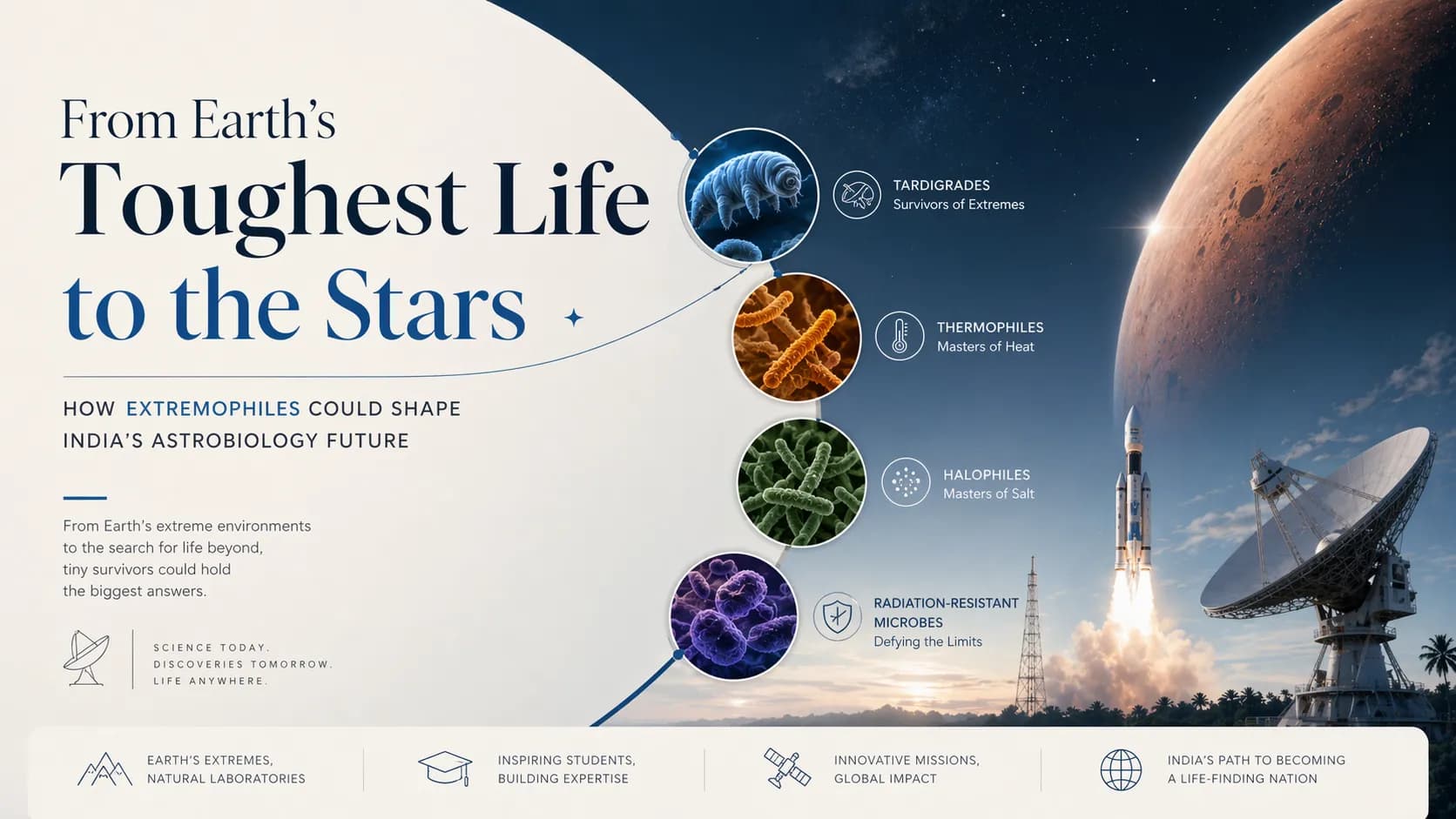
But there have been many developments recently, for example, the CROPS mission (CROPS-1) that is designed to demonstrate germination of a seed and growth of a plant up to the two-leaf stage in space, or even microgravity studies on amazing life forms such as tardigrades as a part of the Voyager Tardigrades project. These experiments hint at a larger truth: space isn’t an empty void, but a testing ground for the resilience of life. If India wants to find aliens, our best teachers may be microbes that treat acid, radiation, and near-vacuum like a warm cup of chai.
So what are extremophiles, really? They’re not only an example of the toughest life forms we’ve ever seen, but they are the microscopic key to scientific leaps in the field of astrobiology. Extremophiles are microorganisms that have the ability to survive in conditions that normal animals or plants can’t, for example, halophiles that live in excessively salty biomes or thermophiles that thrive even in hot-water springs or deep-sea hydrothermal vents. Treating these organisms as mere ‘edge cases’ risks building instruments that see only the familiar. If life can adapt to Earth’s harshest edges, our instruments must adapt to find it elsewhere.
India’s edge is its living canvas of extremes: Mirror-bright salt pans of Rann of Kutch, oxygen-thin heights of the Himalaya, and scalding springs that steam like the breath of the Earth. Each is a natural lab where microbes invent improbable solutions: metal-chewing enzymes, salt-armoured membranes, heat-proof protein scaffolds. However, simply supporting senior field scientists and veteran researchers isn’t enough. We must integrate astrobiological studies and subjects within university education levels. Field modules in deep-sea vents, salt flats, hot springs, and high-altitude lakes could be paired with lab work simulating Martian brines or Europa’s pressure-cooker oceans. Cross-department collaborations could have astrobiology students co-design experiments with aerospace engineers. Not only would this give bright minds exposure to real, rigorous space studies, but also train a generation fluent in reading the fingerprints of life across worlds.
India is a land shaped by centuries of scientific breakthroughs. The earliest biological studies here root from the Sushruta Samhita, a volume of Ayurvedic texts written by the sage Sushruta around 1500-500 BCE. Now, in the 21st century, India is well on the path to becoming a leading scientific and technological force in the world. Our next leap is not only to go farther, but to see finer: to graduate from a spacefaring nation to a life-finding nation. Align universities, ISRO, and industry around this ethos and we turn geography into capability, curiosity into hardware, and students into mission architects.

Perhaps, one day, we will hear a faint echo of a ping from a mission sent far beyond the reaches of the present, and smiling faces back in the ground stations of Indian space companies will look to the sky with quiet satisfaction and confidence.
Originally published in Beyond the Horizon , the official magazine of Skygaze India.