The Night Sky Before Light Pollution
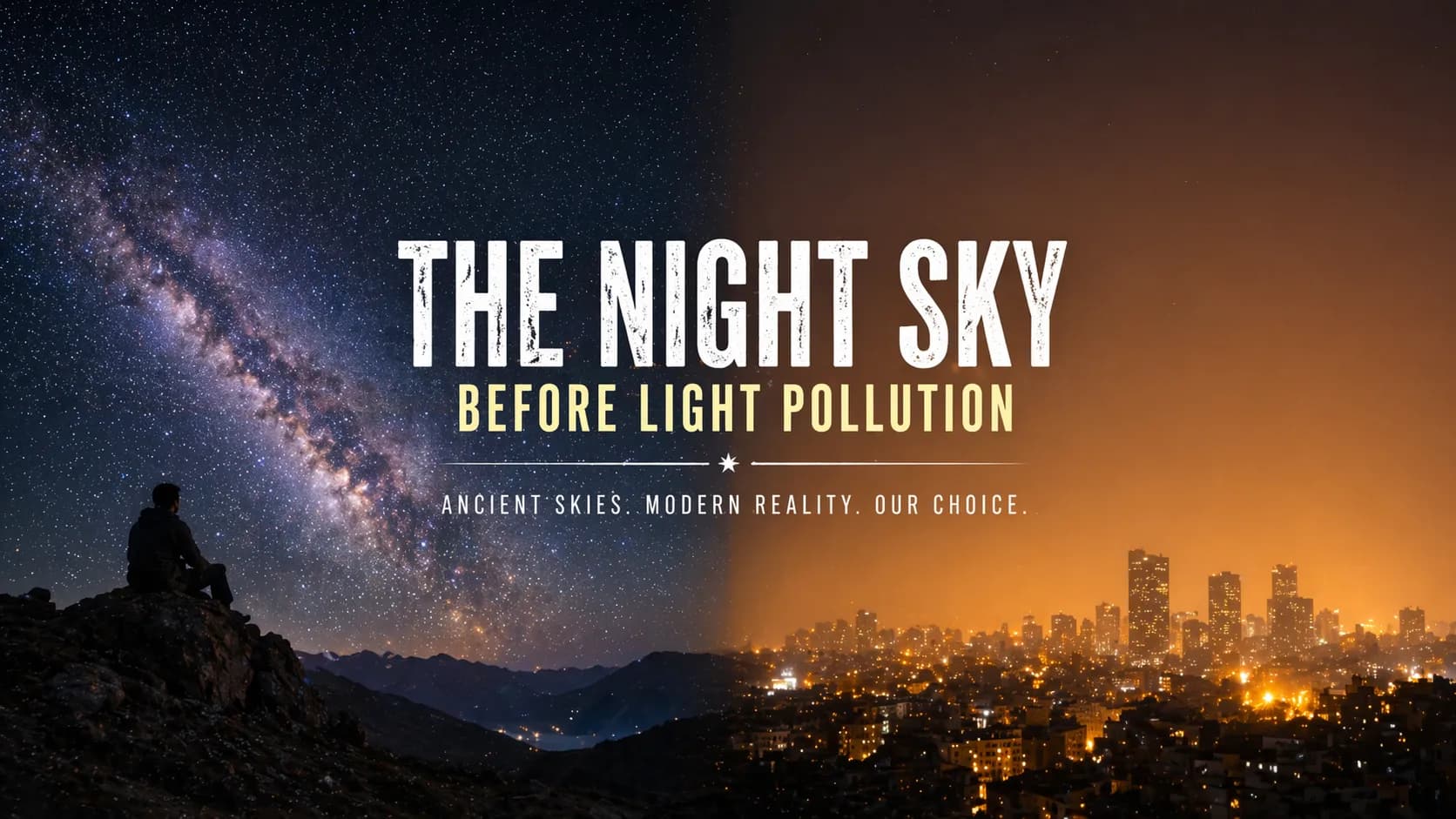
The same sky, two realities: untouched darkness and urban glow.
There was a time when the night sky was not something you had to search for—it was something you lived under. Step outside after sunset, and the darkness would slowly unfold into a canvas filled with countless stars. The Milky Way stretched across the sky like a faint river of light, clearly visible to the naked eye. For most of human history, this was normal. What we now consider a rare, almost magical sight was once an everyday reality.
Ancient skies were darker not because the stars were brighter, but because the Earth below was dimmer. Before electricity, the only sources of light at night were natural—moonlight, starlight, and occasional fire. This meant the human eye could fully adapt to darkness. Scientifically, our eyes take about 20–30 minutes to adjust to low light, a process called dark adaptation. Once adapted, the eye becomes sensitive enough to detect faint stars that are otherwise invisible in bright conditions. In truly dark skies, a person can see up to 5,000 stars at once. Today, in most cities, that number drops to just a few dozen.

The difference comes down to something surprisingly simple: excess light. Light pollution occurs when artificial lighting—streetlights, buildings, billboards—spills upward and scatters in the atmosphere. Tiny particles in the air, such as dust and water vapor, reflect and diffuse this light, creating a glow that brightens the night sky. This effect is called skyglow, and it acts like a veil, hiding the faint light from distant stars and galaxies. It’s not that the stars disappear—they are simply overpowered.
In ancient India, the night sky was not just observed; it was understood and integrated into daily life. Farmers tracked seasons using constellations, travelers navigated using stars, and scholars studied planetary movements with remarkable accuracy. Structures like Jantar Mantar stand as evidence of how deeply connected people once were to the sky. Without light pollution, these observations were not limited to experts—anyone could look up and see patterns, movements, and changes with clarity.
Today, that connection has weakened, especially in urban India. In cities like Delhi or Mumbai, the night sky rarely gets truly dark. Even at midnight, a faint orange or white glow lingers overhead. This constant brightness prevents our eyes from fully adapting, reducing what we can see. The Milky Way, once a prominent feature, has vanished from most urban skies. For many young people growing up in cities, it’s something they’ve only seen in photographs.

The impact of light pollution goes beyond astronomy. It affects ecosystems, human health, and even our sense of time. Many animals rely on natural light cycles for navigation and behavior. Artificial lighting disrupts these patterns—birds become disoriented, insects are drawn away from their natural habitats, and nocturnal animals struggle to function. For humans, excessive exposure to artificial light at night can interfere with sleep by affecting melatonin production, the hormone that regulates our internal clock.
What makes this issue particularly striking is that it is entirely reversible. Unlike air or water pollution, light pollution can be reduced almost immediately by changing how we use light. Shielding lights so they point downward, using warmer tones instead of harsh white LEDs, and turning off unnecessary lighting can significantly restore darkness. In places where such measures have been adopted, the night sky has begun to return.
In India, there are still regions where the ancient sky survives. Remote areas like Ladakh, Spiti Valley, and parts of Rajasthan offer glimpses of what the night once looked like—dense star fields, visible constellations , and the faint glow of the Milky Way. Standing under such a sky can be a powerful experience. It is not just about seeing more stars; it is about rediscovering a perspective that modern life has slowly taken away.
Recognizing this growing disconnect, organizations like Skygaze India are working to bring the night sky back into people’s lives—especially in regions like Delhi NCR, where light pollution is at its peak. By organizing stargazing sessions, awareness drives, and educational outreach, they aim to help urban communities rediscover what has slowly faded from view. More importantly, they are actively looking to collaborate with institutions, schools, and organizations that share the intention of spreading awareness about dark skies and the importance of preserving them.
The night sky before light pollution was not extraordinary—it was ordinary. What has changed is not the universe above us, but the way we illuminate the world below. As we move forward with technology and urban growth, the question is not whether we can eliminate light, but whether we can use it wisely. Because beyond the horizon of our cities, the stars are still there—waiting to be seen again.