Understanding Anatomy of Black Hole
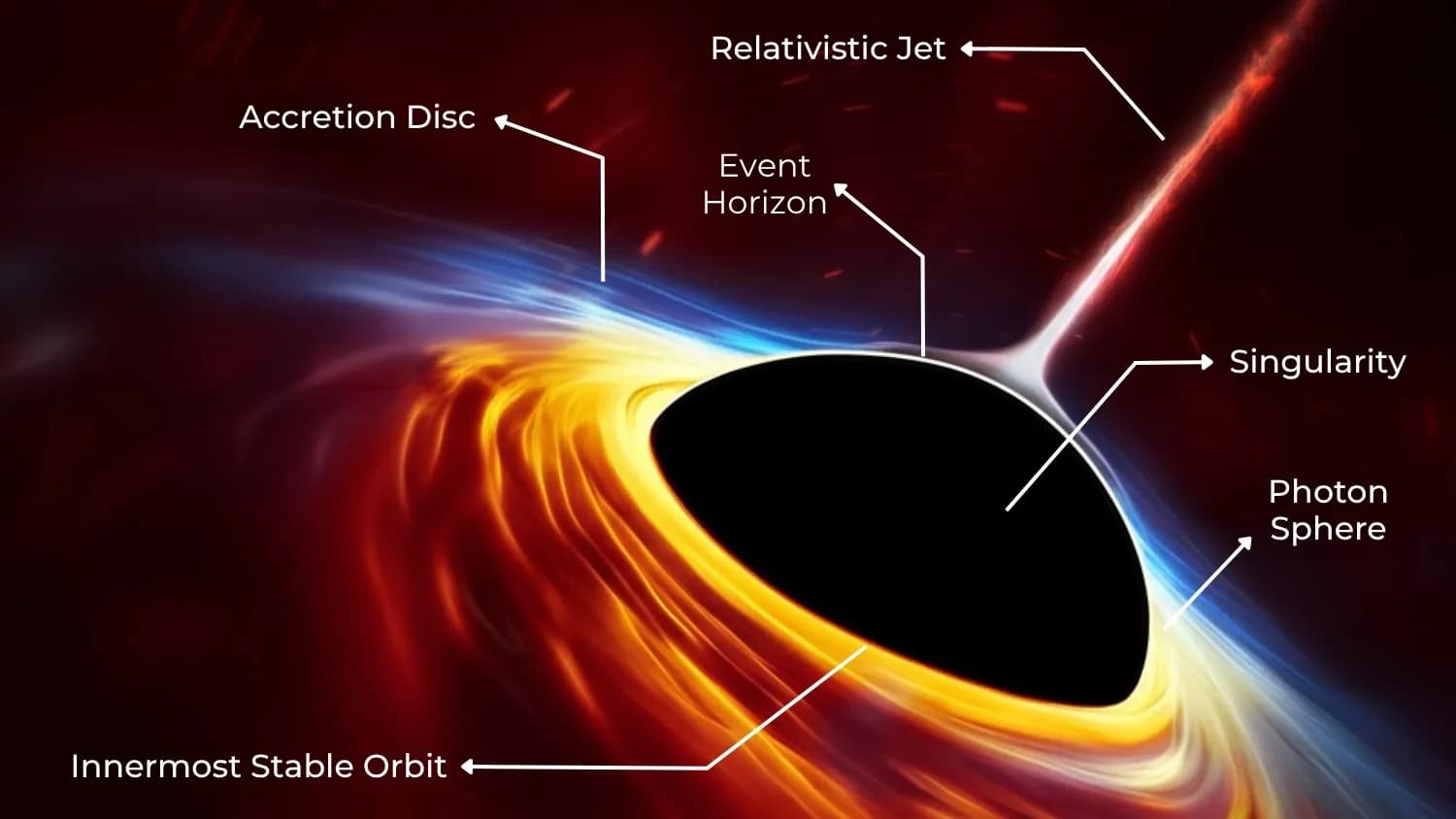
Anatomy of Black Hole
Singularity: The singularity is the center of a black hole where all the matter is squeezed into an extremely small point. It has infinite density and gravity so strong that nothing can escape.
Event horizon: It is the boundary around a black hole. Once something crosses this point, it can’t come back — not even light. It’s like a one-way door into the black hole, which is why black holes appear completely dark from the outside.
Photon Sphere: The photon sphere is a region just outside the event horizon where gravity is so strong that light can orbit the black hole. Light may spin around for a short time before falling in or escaping, creating glowing rings and strange effects in black hole images.
Accretion Disc: An accretion disc is a ring of hot gas and dust spinning around a black hole. As the material gets pulled in, it heats up and glows brightly, giving off light and X-rays. This glowing disc helps scientists detect black holes even though the black hole itself is invisible.
Innermost Stable Orbit: This is the closest distance from a black hole where something can safely orbit without falling in. If an object gets even slightly closer, it will spiral into the black hole. It marks the limit between a stable path and being pulled in forever.
Relativistic Jets: Some black holes shoot out jets of energy from their poles. These powerful beams are formed by fast-spinning gas and magnetic fields outside the black hole. The jets move close to the speed of light and can stretch for thousands of light-years into space.