AQI and GRAP Explained: What Delhi-NCR’s Air Quality Numbers and Restrictions Mean
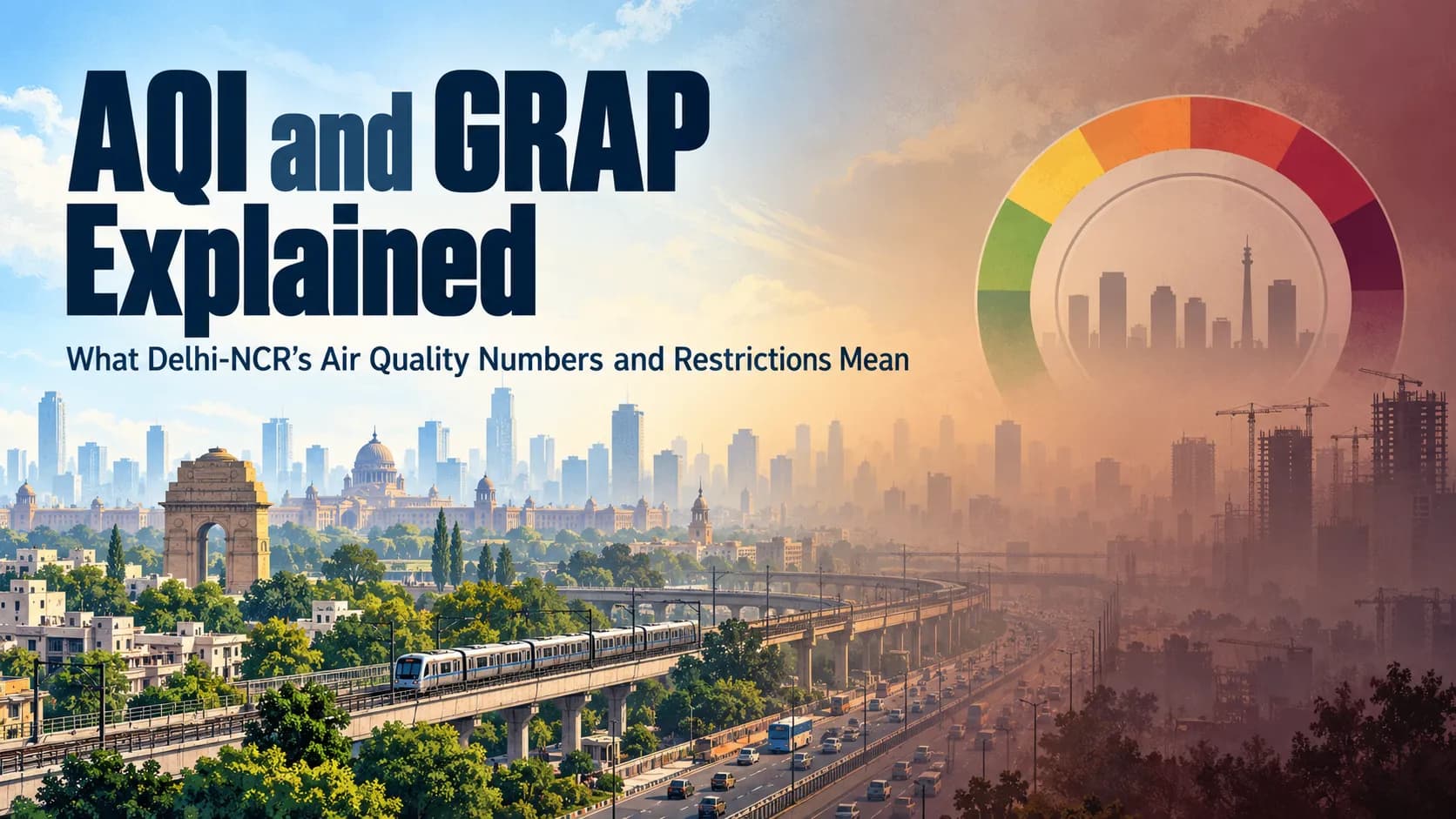
AQI measures air quality, while GRAP determines the regulatory response to deteriorating conditions in Delhi-NCR.
AQI tells you how polluted the air is and what that pollution may mean for health. GRAP is the emergency response system used across Delhi-NCR when air quality deteriorates or is forecast to worsen. They are connected, but they are not the same thing.
That distinction becomes important every winter. A phone may show an AQI reading while a news alert announces a GRAP stage. Schools, offices, construction sites and vehicle owners may then receive separate directions. Unless the terms are understood properly, the information can sound more confusing than it needs to be.
What Does AQI Mean?
AQI stands for Air Quality Index. It converts measurements of different air pollutants into a single number and category that people can understand more easily.
India’s National AQI considers pollutants including PM2.5, PM10, nitrogen dioxide, sulphur dioxide, carbon monoxide, ozone, ammonia and lead. The overall AQI is driven by the highest calculated sub-index among the pollutants for which adequate data are available.
In practical terms, the number is a public-health indicator- not a weather forecast and not a GRAP order.
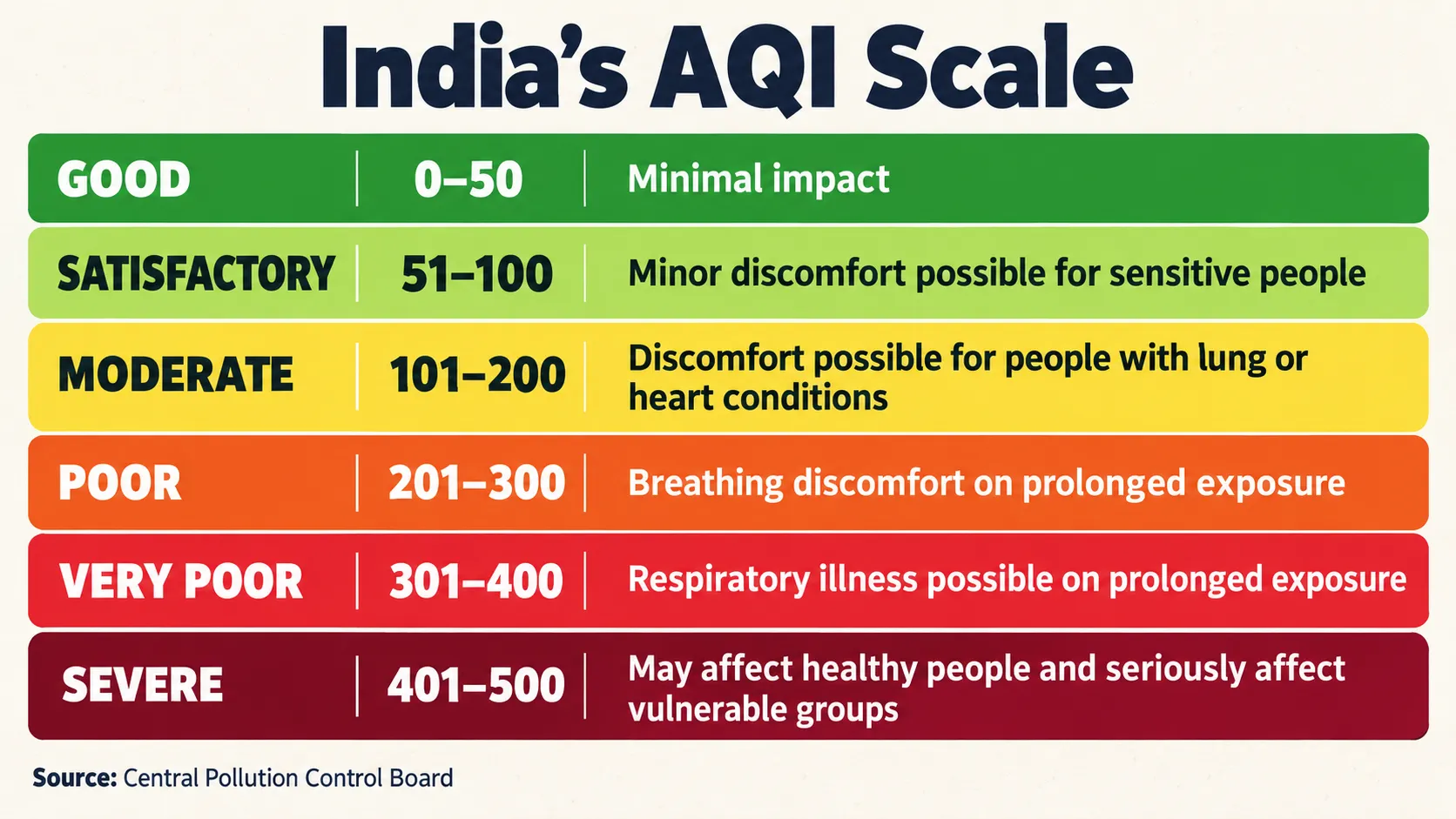
The Central Pollution Control Board divides AQI into six categories:
Good: 0–50: Air quality is considered to have minimal health impact.
Satisfactory: 51–100: Sensitive people may experience minor breathing discomfort.
Moderate: 101–200: People with lung or heart conditions, children and older adults may experience discomfort.
Poor: 201–300: Prolonged exposure may cause breathing discomfort.
Very Poor: 301–400: Prolonged exposure may lead to respiratory illness, with stronger effects possible for people with heart or lung conditions.
Severe: 401–500: The air may affect healthy people and can have serious effects on people with existing heart or lung conditions.
AQI Can Vary Across the Same City
A reading from one monitoring station does not necessarily represent every neighbourhood.
Traffic, road dust, construction, industrial activity, local burning, wind direction and weather conditions can produce different readings across Delhi-NCR. AQI can also change during the day.
When checking the air, look at:
the location of the monitoring station;
the time of reading;
the dominant pollutant, if shown;
whether the number is a live reading, daily average or forecast.
This is one reason two applications may appear to show different values. They may be using different stations, averaging periods or data sources.
For official information, readers can check the CPCB National Air Quality Index portal.
What Is GRAP?
GRAP stands for the Graded Response Action Plan. It is an emergency-response mechanism for the National Capital Region, coordinated by the Commission for Air Quality Management.
GRAP brings together different authorities to introduce progressively stronger pollution-control measures as air quality worsens.
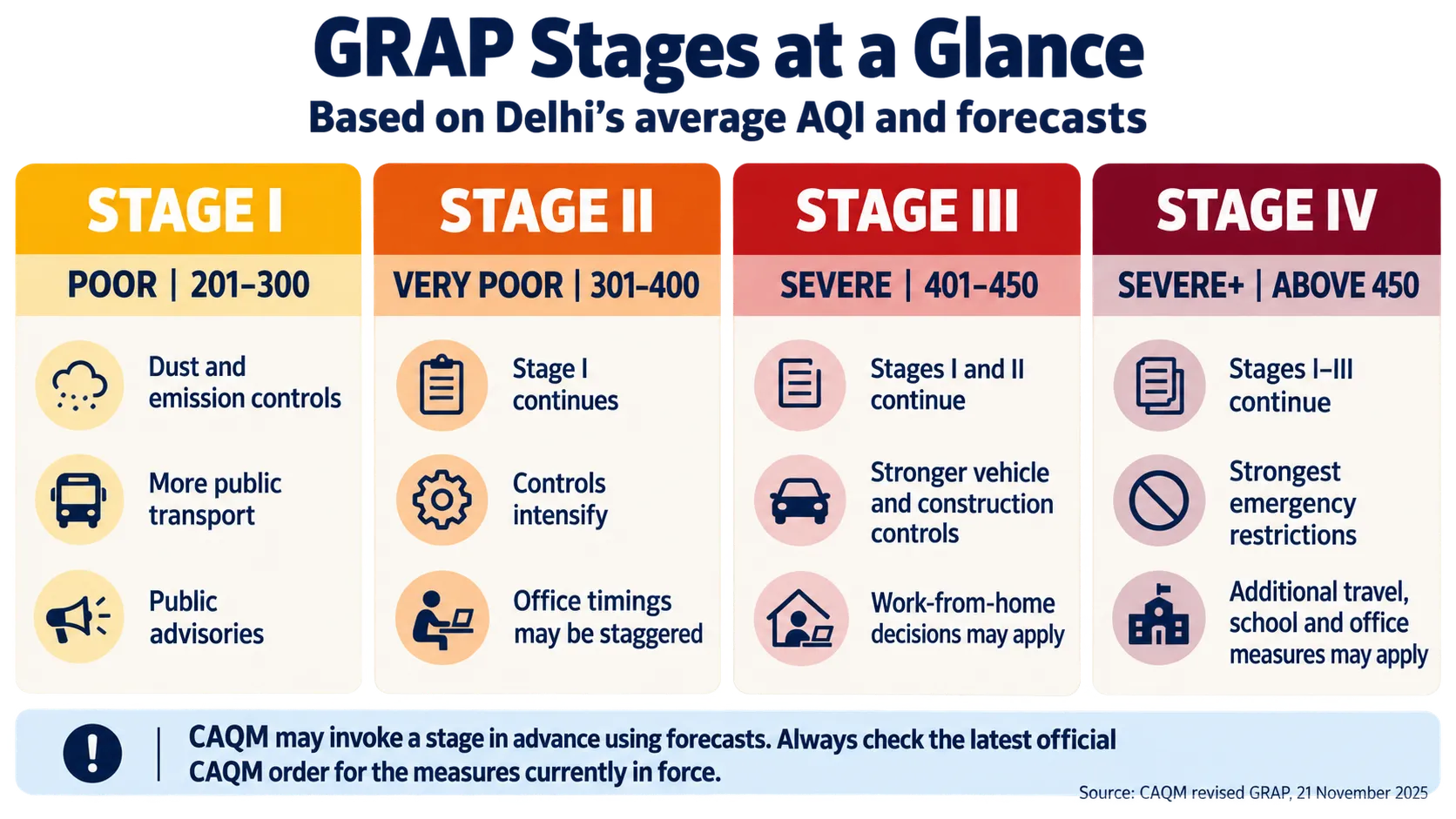
CAQM approved a revised GRAP schedule on 28 September 2026, ahead of the winter pollution season. It has four stages based on Delhi’s average AQI and air-quality forecasts:
Stage I — Poor: AQI 201–300
Stage II — Very Poor: AQI 301–400
Stage III — Severe: AQI 401–450
Stage IV — Severe+: AQI above 450
GRAP applies across the NCR, but its stages are linked to Delhi’s average AQI and forecasts. This is different from checking the AQI at one neighbourhood monitoring station.
Why the Active GRAP Stage May Not Match the AQI on Your Phone
CAQM does not need to wait for the AQI to cross a threshold before acting.
Under the revised plan, a stage can be invoked in advance when weather and air-quality forecasts indicate that pollution is likely to reach and remain within that category. A stage can also be imposed quickly if an unexpected episode causes the AQI to rise sharply.
Similarly, a GRAP stage does not disappear automatically the moment the AQI improves. The CAQM Sub-Committee reviews current readings, forecasts and meteorological conditions before issuing an order to invoke, continue or revoke measures.
The active stage should therefore be confirmed through the latest CAQM GRAP order, not inferred from a single reading.
What Happens Under Each GRAP Stage?
GRAP measures are cumulative. When a higher stage is introduced, measures from the earlier stages generally continue unless an official order says otherwise.
Stage I: Poor Air Quality
Stage I applies when Delhi’s average AQI is between 201 and 300. It now contains 25 actions and begins several controls earlier in the pollution cycle.
The September 2026 revision consolidates repeated measures relating to dust, municipal solid waste and transport. Measures concerning diesel generator sets and the entry into Delhi of BS-IV-and-below buses from NCR and adjoining states have also moved from Stage II to Stage I.
Other Stage I measures can include dust and emission controls, action against open burning, public advisories, traffic management and the augmentation of public transport.

Exact requirements and exemptions should be checked in the applicable CAQM order.
Stage II: Very Poor Air Quality
Stage II applies when Delhi’s average AQI is between 301 and 400. Its eight actions operate in addition to the measures already in force under Stage I.
Controls and enforcement are intensified as air quality deteriorates. Provisions introduced earlier concerning staggered timings for public offices and municipal bodies may continue to apply according to the relevant government and CAQM directions.
Because diesel-generator and older inter-city bus measures have moved to Stage I under the 2026 revision, readers should not rely on older charts that continue to show those controls beginning only at Stage II.
Stage III: Severe Air Quality
Stage III applies when Delhi’s average AQI is between 401 and 450. Its 10 actions operate alongside the measures under Stages I and II.
Restrictions on the use of BS-III petrol and BS-IV diesel—or lower-standard—light motor vehicles have been extended to Sonipat, in addition to Gurugram, Faridabad, Ghaziabad and Gautam Budh Nagar.
The revised schedule also expressly addresses the entry into Delhi of diesel-operated BS-IV-and-below light and medium goods vehicles registered outside Delhi. An earlier exemption for certain older goods vehicles carrying essential commodities has been removed.
Construction and demolition restrictions may also apply, although the revised framework provides a limited relaxation for specified work, including pothole repairs. Readers should check the exact CAQM order for permitted activities, exemptions and geographical coverage.
Stage IV: Severe+ Air Quality
Stage IV applies when Delhi’s average AQI rises above 450. Its five actions are added to the measures already operating under Stages I, II and III.
This stage introduces the strongest emergency restrictions. These may affect the entry and movement of goods vehicles, construction activity, schools, offices and other emission-generating operations.
Under the 2026 revision, the exemption previously available to certain BS-IV-and-below trucks and heavy goods vehicles carrying essential commodities has been removed. The precise restrictions, exceptions and implementation dates must be confirmed through the latest CAQM order.
Construction Dust Monitoring Has Also Been Expanded
Eligible construction and demolition projects outside municipal limits may now also come under web-portal registration and monitoring requirements. This can include projects in controlled areas, development and industrial-development areas, industrial zones and highway-corridor zones, depending on the applicable planning framework.
Does a GRAP Stage Automatically Close Schools?
Not necessarily.
GRAP provides the emergency framework, but specific arrangements for physical classes, hybrid learning or closures are communicated through official government & education-authority orders.
Parents should rely on notices from the school & the relevant state or district authority.
What Should Residents Do When AQI Rises?
Government action and individual precautions serve different purposes. GRAP attempts to reduce emissions; personal decisions can help reduce exposure.
When air quality reaches the poorer categories:
check official AQI information before planning prolonged outdoor activity;
pay particular attention if you have asthma, heart disease or another condition affected by air pollution;
follow your doctor’s existing advice and keep prescribed medication available;
avoid adding to local pollution through waste burning or unnecessary vehicle idling;
use public transport or shared travel where practical;
keep indoor spaces free from tobacco smoke, incense and other avoidable combustion;
watch for official school, workplace and transport directions.
Seek medical advice if you develop persistent breathlessness, chest discomfort, wheezing or another concerning symptom.
Check the Order, Not Just the Headline
A headline saying “GRAP III imposed” tells only part of the story. Residents and businesses may still need to know:
when the order takes effect;
whether it covers the entire NCR;
which activities are restricted;
which exemptions apply;
whether an earlier stage remains in force;
whether a later order has modified or revoked the restrictions.
The CAQM website publishes GRAP orders and revisions.
AQI Is the Reading; GRAP Is the Response
The simplest: AQI describes the condition of the air, while GRAP sets out the regulatory response to worsening air quality in Delhi-NCR.
This article provides general public-information content and not medical or legal advice. AQI readings, GRAP stages and applicable restrictions can change. Refer to current CPCB, CAQM and government notifications before making decisions.