Festive Online Shopping Scams in India
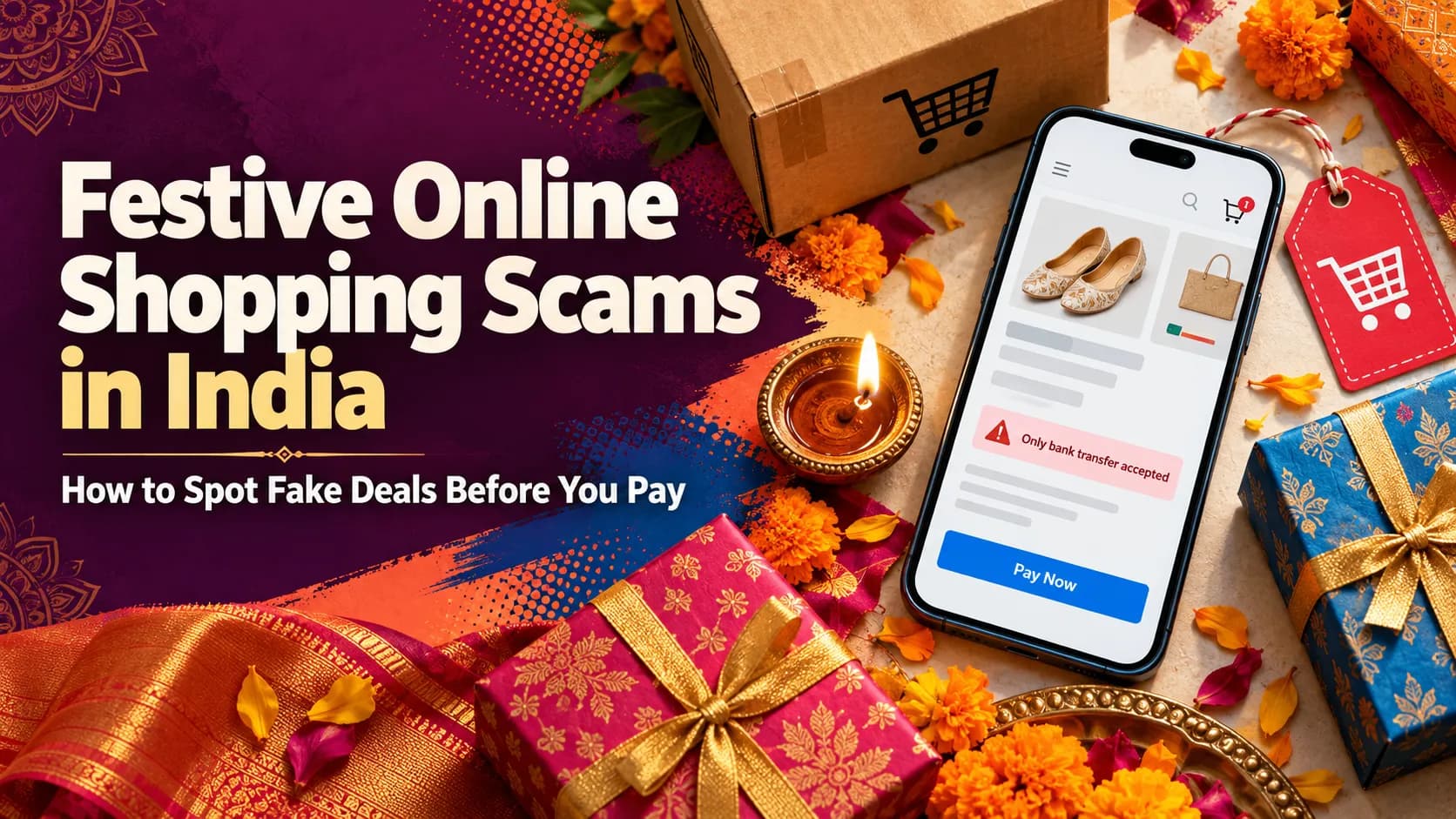
Verify the seller, website and payment recipient before completing an order.
How to Spot Fake Deals Before You Pay? A practical Diwali 2026 guide to checking festive discounts, sellers, payment links and refund messages
Updated: 1 October 2026
With Diwali approaching, festive offers are appearing everywhere—from established marketplaces to unfamiliar websites and social-media stores. The safest response is not to distrust every discount, but to verify the website, seller, final price and payment recipient before paying.
Online shopping scams work particularly well during sale periods because buyers expect unusually low prices, short deadlines and frequent promotional messages. A fake advertisement or payment link can therefore look like one more festive offer in a crowded feed.
Online-Shopping Problems Are Already Significant
According to the Department of Consumer Affairs, the National Consumer Helpline received 17,71,622 grievances during 2025. Of these, 5,11,196—approximately 29%—related to e-commerce.
These were consumer grievances, not necessarily confirmed fraud cases. They can include non-delivery, defective products, misleading listings, refund delays and other disputes.
Cyber fraud is a separate and broader category. Government figures cited in 2026 indicate that India recorded 28.15 lakh cyber-fraud complaints involving reported losses of ₹22,495 crore during 2025. These figures cover multiple types of cyber fraud and must not be presented as Diwali-shopping losses.
The numbers still establish an important distinction: a problem involving a genuine seller may require consumer redressal, while a fake website, fraudulent payment link or stolen account requires immediate cybercrime reporting.
Fake Shopping Websites Can Look Convincing
A fraudulent website may imitate a recognised retailer or present itself as a new premium brand. Product photographs can be copied, reviews fabricated and contact information invented.
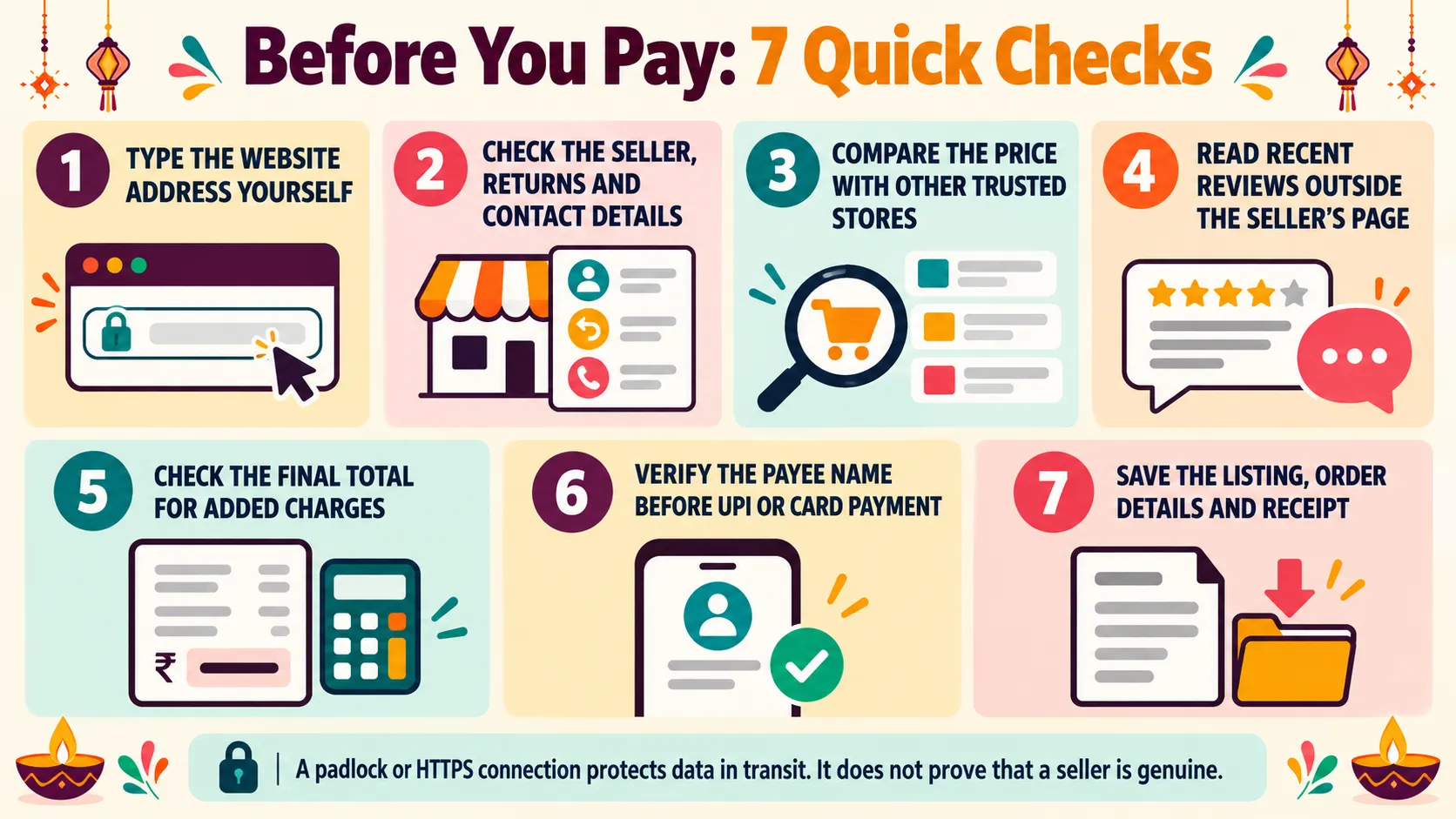
Examine the website address carefully. An additional letter, unusual spelling or unfamiliar domain may indicate an imitation site. Type a known retailer’s address yourself or use its verified application instead of opening a link forwarded through SMS, email or social media.
Do not rely entirely on the padlock symbol or an HTTPS connection. Encryption protects information while it travels between your device and a website. It does not establish that the business receiving the information is genuine.
The Indian Cyber Crime Coordination Centre advises shoppers to use familiar websites and cautions that search results can lead to malicious sites.
Check Social-Media Sellers Before Ordering
A polished social-media profile is not the same as a verified business.
Fraudulent sellers may use copied product videos, purchased followers and fabricated customer comments. After receiving payment, the account may stop responding, disappear or send a product of little value.
Before purchasing from a social-media store:
check how long the account has been active;
look for recent complaints in its comments;
search for the business name outside the platform;
verify its address, email and telephone number;
read the return and replacement policy;
request an invoice;
be cautious if comments are disabled;
question payments directed to an unrelated personal account.
No single check proves that a seller is legitimate. Together, however, these steps make deception more difficult.
Urgency Can Be Part of the Sales Tactic

“Only two left.” “Sale ends in five minutes.” “Twenty people are viewing this product.”
Some alerts reflect genuine availability. Others are designed to stop buyers from pausing.
The Central Consumer Protection Authority identifies false urgency, basket sneaking, bait and switch, drip pricing and interface interference as forms of dark patterns. These are online designs that manipulate consumers into decisions they did not originally intend to make.
Watch for:
products, donations or services added automatically to the basket;
a low advertised price that increases during checkout;
pre-selected insurance or subscription options;
hidden delivery or handling charges;
a deal that changes after it is selected;
repeated prompts intended to wear down the buyer;
a countdown that resets when the page is reopened.
A dark pattern is not necessarily a criminal shopping scam. It can appear on an otherwise genuine platform, but it may still constitute a deceptive or unfair trade practice.
Check the Seller, Not Just the Product
A product page is built to make an item look appealing. Your verification should focus on the business behind it.
Search the seller’s name with words such as “complaint”, “refund” and “fraud”. Read recent reviews on more than one website. Identical wording, sudden clusters of five-star ratings or vague comments that never mention the product may be warning signs.
Check the return period, refund process, cancellation rules, delivery charges and warranty conditions before paying. Save screenshots of the listing, price and promised delivery date. A seller can modify or remove a webpage after an order is placed.
Be Careful When a Seller Moves the Payment Elsewhere
A seller may ask you to leave the marketplace and complete the order through WhatsApp or a direct bank transfer. That can remove transaction records and dispute mechanisms provided by the platform.
Pause if:
an additional discount is offered for direct payment;
the payee name does not match the seller;
only prepaid UPI or bank transfer is accepted;
the seller refuses to issue an invoice;
a new payment link arrives through a message;
you are asked to install an unfamiliar application;
the payment page requests information unrelated to the purchase.
Before authorising a UPI payment, verify the recipient’s displayed name and the amount.
NPCI warns that scanning a QR code and entering a UPI PIN are actions used to make a payment—not to receive money. Never disclose your UPI PIN, card PIN, CVV, OTP or password to a seller, courier representative or customer-care caller.
The Refund Scam Can Begin After the Order
A caller may claim that your payment failed, your parcel is being held or you are entitled to a refund. The caller may already know your name, order amount or delivery address.
You may then be asked to:
pay an additional delivery charge;
open a refund link;
install a screen-sharing application;
scan a QR code;
enter a UPI PIN;
disclose an OTP or card detail.
Contact the seller through its official website or application instead. Do not call a customer-care number taken from an unverified advertisement or social-media comment.
Receiving a genuine refund does not require you to scan someone else’s QR code and enter your UPI PIN.
Inspect the Product Before Discarding Its Packaging
Compare the delivered product with the original listing while the return period is still open.
Check whether the model, colour and specifications match the order. Look for disturbed seals, missing accessories, altered labels or obvious signs of a counterfeit product.
For an expensive purchase, a continuous unpacking video can help document what was received. Preserve the invoice, packaging and delivery label until you are satisfied with the order.
Do not publish an image of the delivery label without hiding your address, telephone number and tracking information.
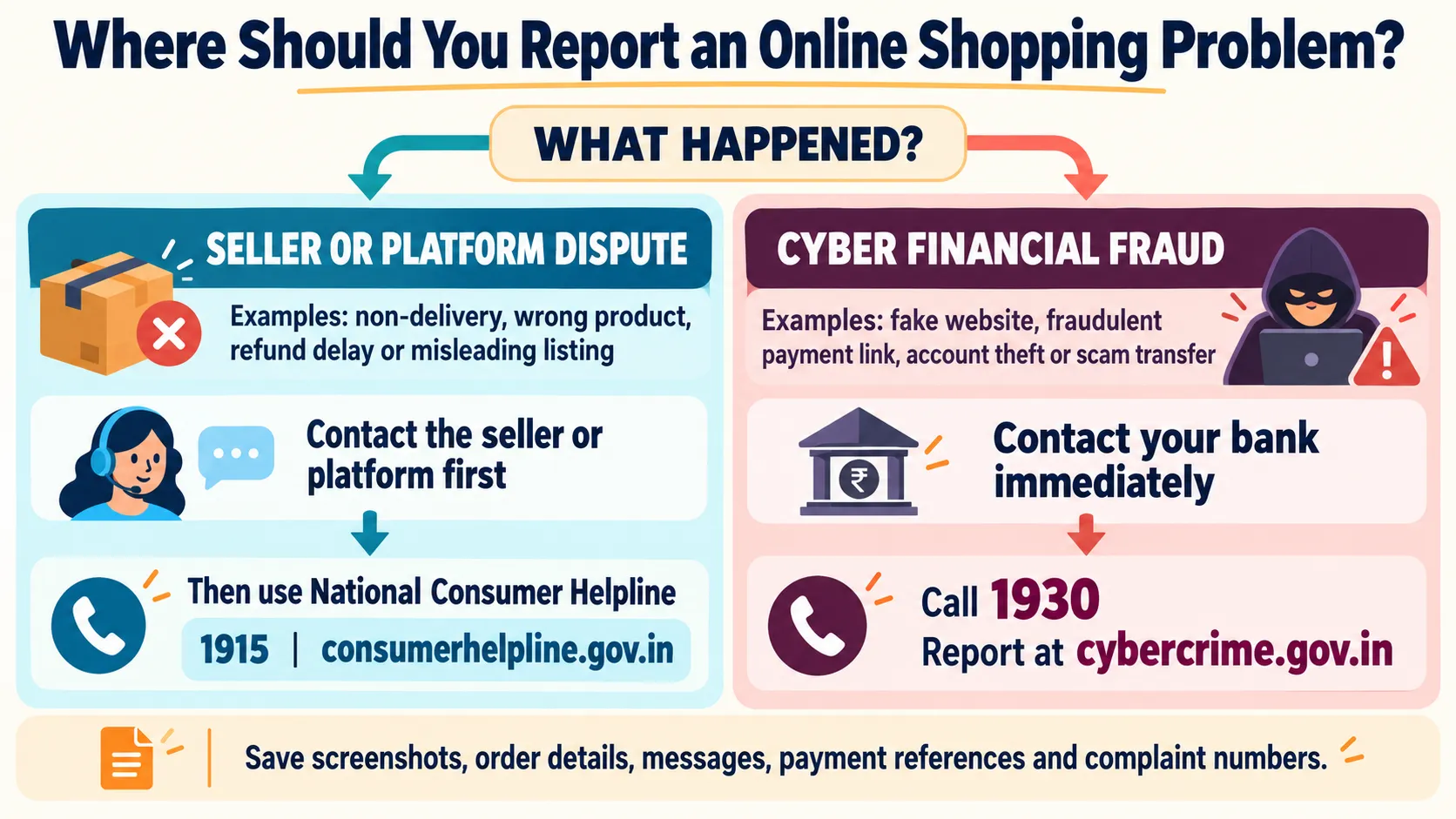
Where Should You Report the Problem?
A delayed refund from an identifiable seller is not automatically cybercrime. Conversely, a fake website that takes money and disappears should not be treated only as a customer-service problem.
Seller or platform dispute
First contact the seller or platform through its official grievance channel. Preserve the complaint number and correspondence.
If the matter remains unresolved, use the National Consumer Helpline or call 1915.
This route may be appropriate for:
non-delivery by an identifiable seller;
receipt of a defective or incorrect product;
misleading product information;
an unresolved cancellation or refund;
an unfair charge or checkout practice.
Cyber financial fraud
Contact your bank or payment provider immediately. Ask it to secure the affected payment facility and register the transaction as suspected fraud.
Call 1930 and file the complaint through the National Cyber Crime Reporting Portal.
This route may be appropriate for:
a fake shopping website;
a fraudulent payment or refund link;
an unauthorised transaction;
a scam transfer;
stolen payment credentials;
an account compromised after installing an unknown application.
Save the transaction reference, UPI ID, account details, website address, social-media handle, messages and screenshots. Quick reporting may help efforts to trace or restrict funds, but it does not guarantee recovery.
A Genuine Discount Can Survive a Two-Minute Check
Festive shopping does not require suspicion of every unfamiliar seller. It does require a little distance from offers designed to make verification feel inconvenient.
Before paying, confirm who operates the store, what the final amount includes, where the money is going and what remedy is available if the order goes wrong.
A genuine discount can survive a two-minute check. A fraudulent one often depends on you not taking it.
This article provides general consumer-awareness information and does not constitute legal or financial advice. Platform policies and official reporting procedures may change. Confirm current information through official government and financial-institution websites.