How Asteroids and Comets Built Our Solar System
The universe has always invited one profound question — are we truly alone?
This article explores one of modern science’s most fascinating frontiers: the multiverse theory, the idea that our universe might be just one among countless others.
It begins by revisiting the scientific revolution of the twentieth century, when quantum mechanics replaced the predictable world of Newton and Einstein with one ruled by probability. Through phenomena such as quantum entanglement — what Einstein once called “spooky action at a distance” — we learn that the very fabric of reality can defy our common sense of space, time, and causality.
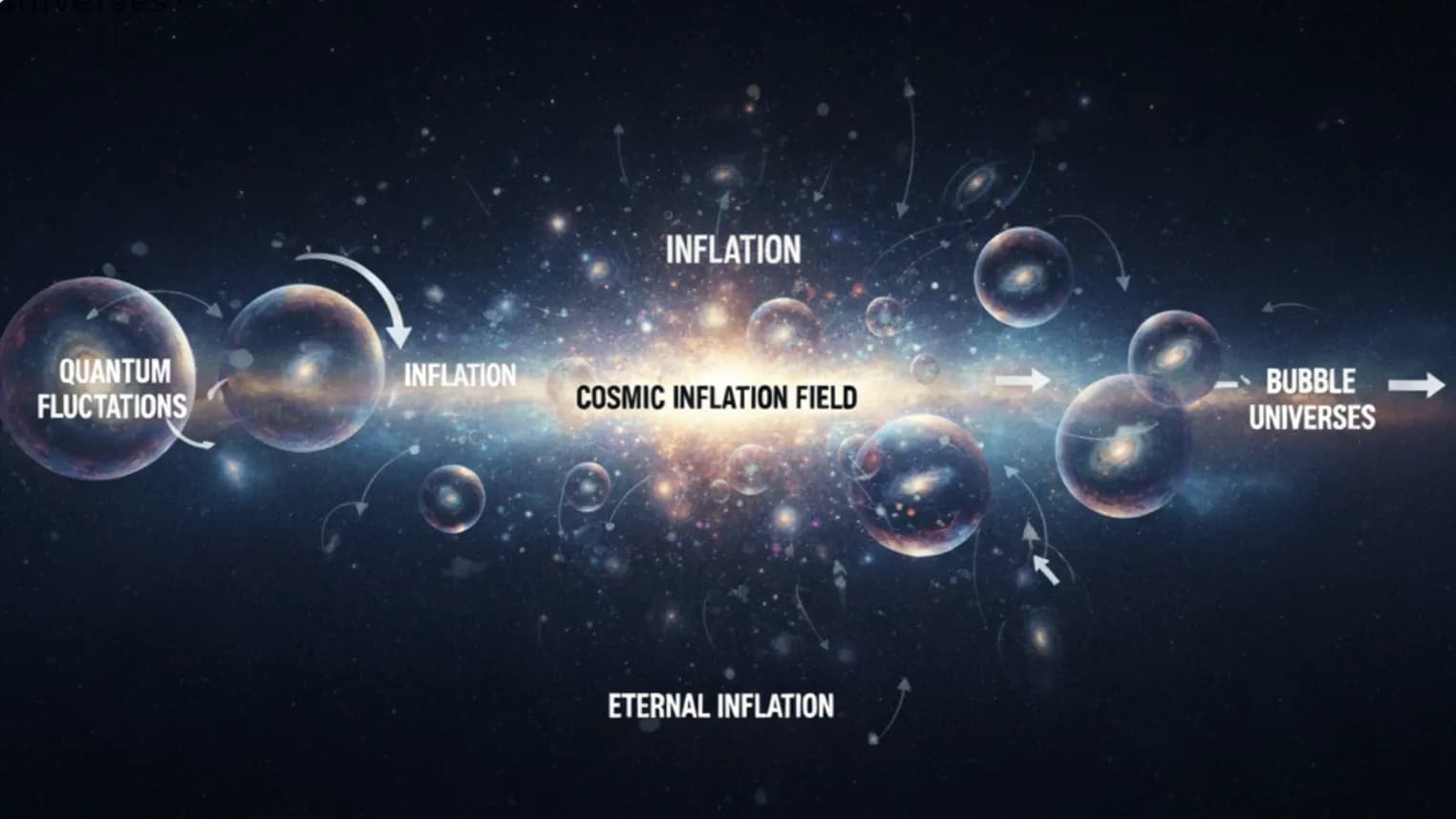
Building upon this quantum foundation, the discussion expands to a cosmic scale, connecting ideas such as cosmic inflation (the rapid expansion of the early universe) and eternal inflation (the possibility that this process never truly ended). These theories suggest that our universe may be just one bubble in an immense cosmic sea, each bubble potentially shaped by its own physical laws and constants.
Yet, while most scientific discussions of the multiverse focus on physics, this article turns to a more rarely explored dimension — biology.
Here lies the true originality of this work. Rather than treating the multiverse as an abstract physical concept, it asks a deeper question:
“Could life — and especially human life — ever truly be replicated across universes?”
Drawing on insights from molecular biology, environmental science, and astrobiology, the article argues that the emergence of life depends on a precise harmony of factors — chemical compositions, planetary environments, and evolutionary chance — that makes exact repetition nearly impossible.
Even if atoms were arranged identically elsewhere, the birth and growth of life rely on far more than molecular similarity.

This forms the intellectual core of the piece: a critique of the “other versions of us” idea.
Thinkers like Brian Greene and Nick Bostrom have proposed that in an infinite universe, identical copies of you and me could exist somewhere else. Yet this article exposes a biological flaw in that argument.
The complexity of DNA, its dependence on planetary conditions, and the unpredictable nature of evolution make such duplication extraordinarily unlikely.
Even tiny differences — in temperature, atmosphere, or chemical balance — could completely alter the course of evolution. The multiverse may indeed be infinite, but exact human replicas are probably not among its possibilities.
Recent research, such as “Multiverse Predictions for Habitability: The Habitability of Exotic Environments” (2025), supports this reasoning by suggesting that habitable conditions could exist in strange and unexpected forms across the cosmos. The discussion also aligns with NASA’s Astrobiology Primer 3.0, which urges scientists to look beyond Earth-like life and embrace a broader definition of what it means to be “alive.”
Thus, the most plausible vision of the multiverse is not one filled with duplicates of ourselves, but one teeming with diverse and adaptive life forms, each following its own unique rules of complexity and evolution.
In its closing reflection, the article bridges science and philosophy. It argues that truly understanding the multiverse requires more than equations — it demands synthesis, imagination, and humility. The author concludes with a timeless thought:
“Before being a physicist, be a philosopher. And before being a philosopher,
be a thinker who masters the logic of synthesis, rationality, and precision.”
Ultimately, this piece does not just describe the multiverse — it reimagines it.
It turns a speculative scientific idea into a mirror of human curiosity, reminding us that while the cosmos may be infinite, the search for meaning begins within — in our ability to question, reason, and wonder.