Is our universe really of the colours we see in images? Or Is It a Magnificent Lie?
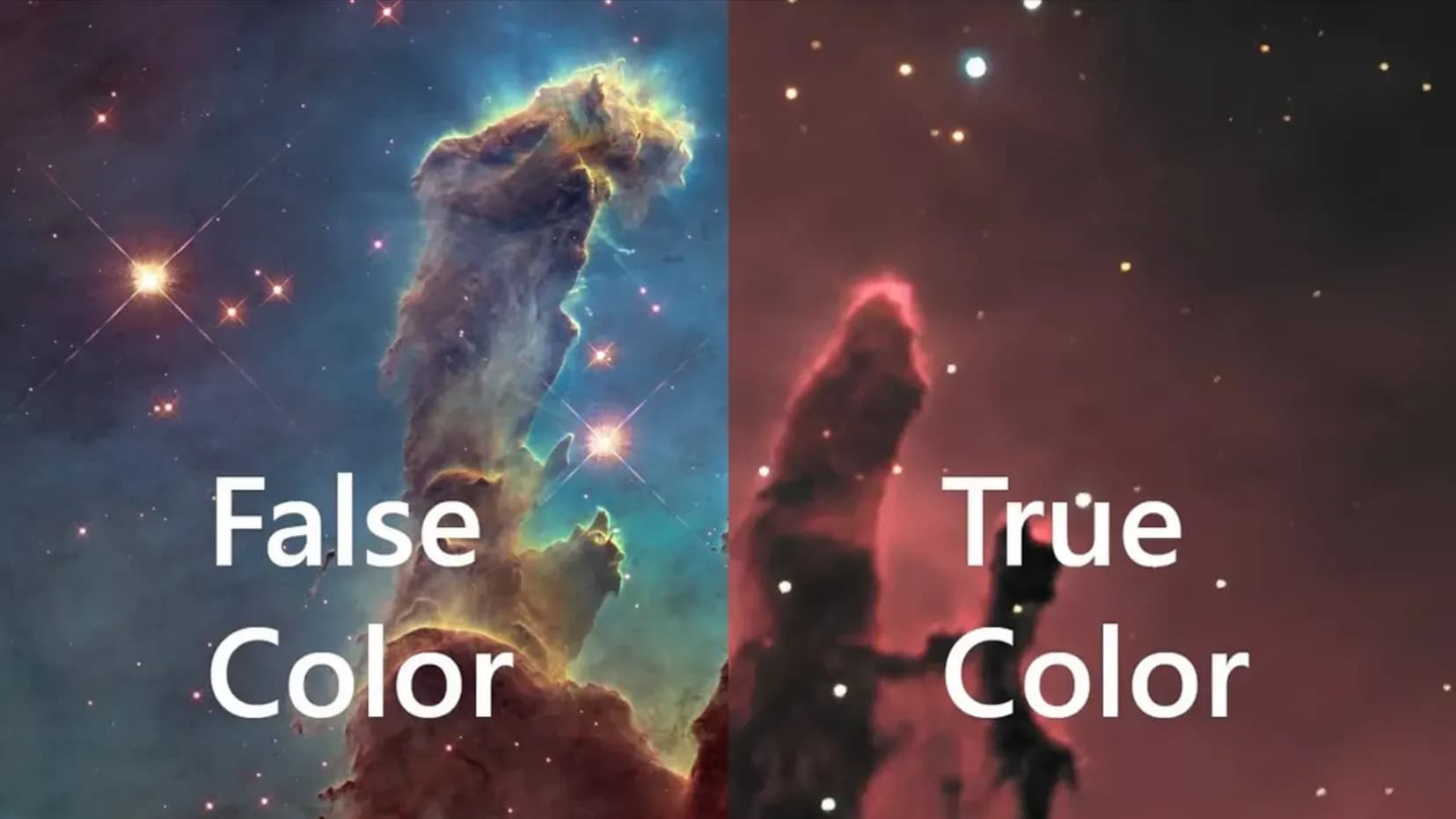
False colouring of Eagle Nebula
Surfing through social media every day, it’s hard not to pause when you see breathtaking images of the universe — vibrant galaxies, radiant stars, and nebulas that look like cosmic artwork. These dazzling visuals mesmerize us, painting an incredible picture of the cosmos in our minds. But amidst this awe, one question often lingers: Are these the
real colours of galaxies, or just an elaborate artistic fabrication?
The answer lies somewhere between “yes” and “no.” It’s a fascinating mix of scientific reality and creative interpretation. Let’s dive deeper into this cosmic mystery.
The Science Behind the colours
Our vision is not complete
The human eye can only perceive a small part of the electromagnetic spectrum — the visible spectrum, which ranges from 380 to 700 nanometers. This is why we see colours from violet to red. However, the universe emits light across a vast range of wavelengths, most of which are invisible to us.
Infrared light reveals cooler objects, such as star-forming regions and dust clouds.
Ultraviolet light showcases energetic phenomena like young stars and starburst galaxies.
X-rays and gamma rays expose high-energy events like black hole activity or supernovae.
Radio waves unveil the cold hydrogen gas crucial for galaxy formation.

Since most cosmic light is outside the visible spectrum, astronomers use specialized telescopes to detect it and translate it into visible colours, revealing the universe in ways our eyes could never see.
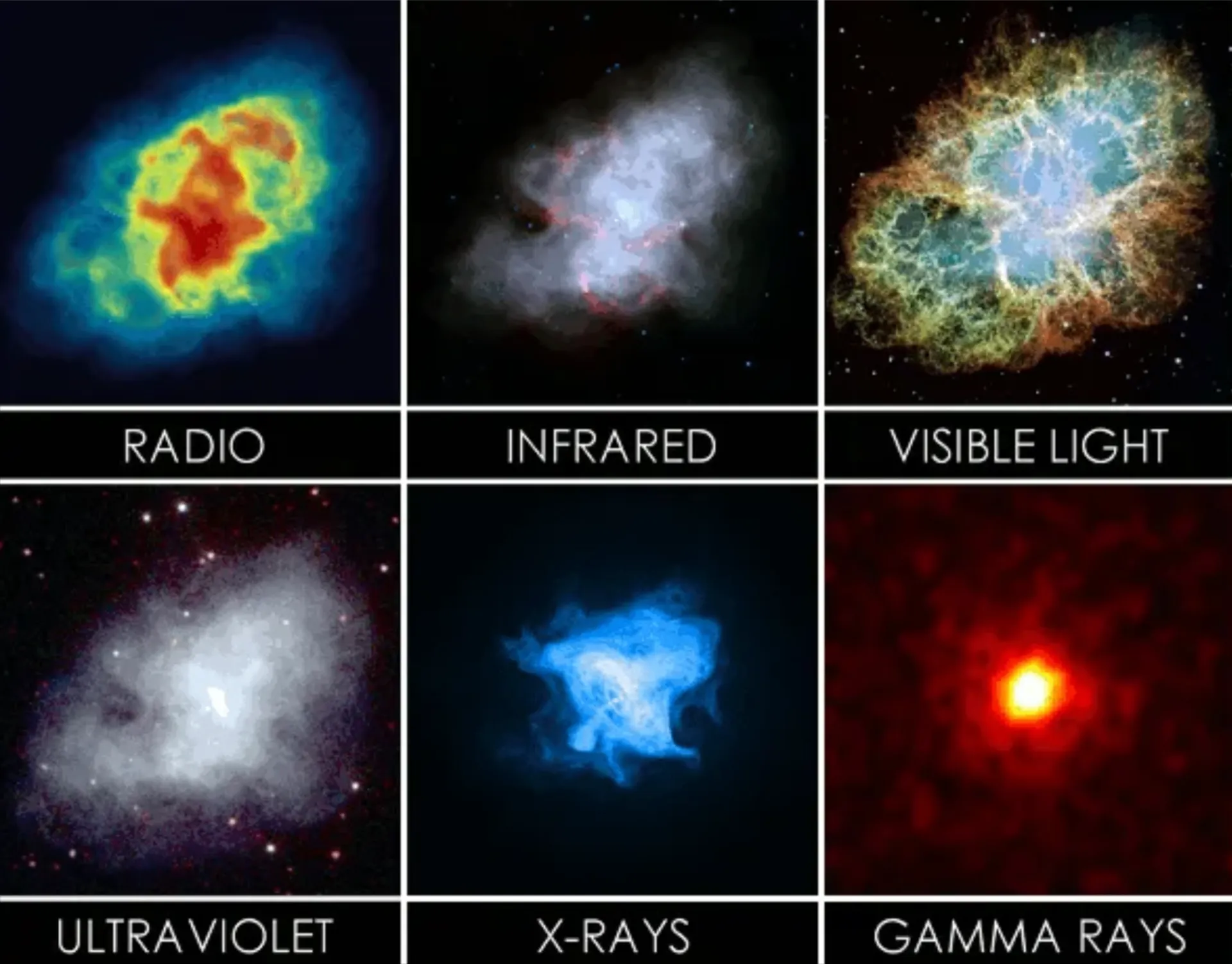
False Colour Imaging: A Tool to See the Unseen
To visualize invisible wavelengths, astronomers use false colour imaging, where specific colours are assigned to wavelengths beyond our vision. This technique isn’t about deception; it’s about revealing the unseen.
For example:
Infrared light might be depicted as red to highlight warm dust and star-forming regions. Ultraviolet light might appear as blue or violet to represent energetic young stars. X-rays and gamma rays might be displayed in vivid hues like purple or green to emphasize extreme cosmic events.
This method helps astronomers’ study complex structures and phenomena that would otherwise remain hidden. By mapping these invisible signals, false colour imaging transforms data into a visually understandable format, bridging the gap between raw science and human perception.
The human eye can only capture light in real-time and struggles with faint objects, especially those billions of light-years away. Telescopes, however, can collect light over extended periods — hours, days, or even weeks. This process, called long-exposure photography, reveals the faintest details of distant galaxies, nebulae, and stars.
Space photos’ colors: not just pretty, but clues to the universe!
Blue and white show us young, hot stars, often busy forming in spiral arms of galaxies. Red and yellow colours tell us about older, cooler stars, usually found in the central parts of galaxies or in elliptical galaxies.
And those cool, unique colours like green? Those are often glowing gas clouds, especially hydrogen gas that’s been energized. They’re great markers for where new stars are born, or even to spot specific elements like oxygen. So, each colour is like a piece of a puzzle, helping scientists figure out how stars live and die, what galaxies are made of, and how the whole universe works!
Is It a Lie?
Far from being a “lie,” the colors we see in galaxy images are representations of reality, crafted to convey the full story of the cosmos. While they may not be what our eyes would perceive directly, they’re based on real data collected from telescopes. These colors are tools, helping us decode the universe’s mysteries and visualize its hidden wonders.
Conclusion: A Magnificent Truth
The vibrant colors of galaxies are not just aesthetic choices; they’re gateways to understanding the universe. Every hue reveals secrets about star formation, chemical processes, and cosmic evolution.
Originally published in Beyond the Horizon , the official magazine of Skygaze India.