What Is Dark Matter Really Made Of? — exploring leading theories
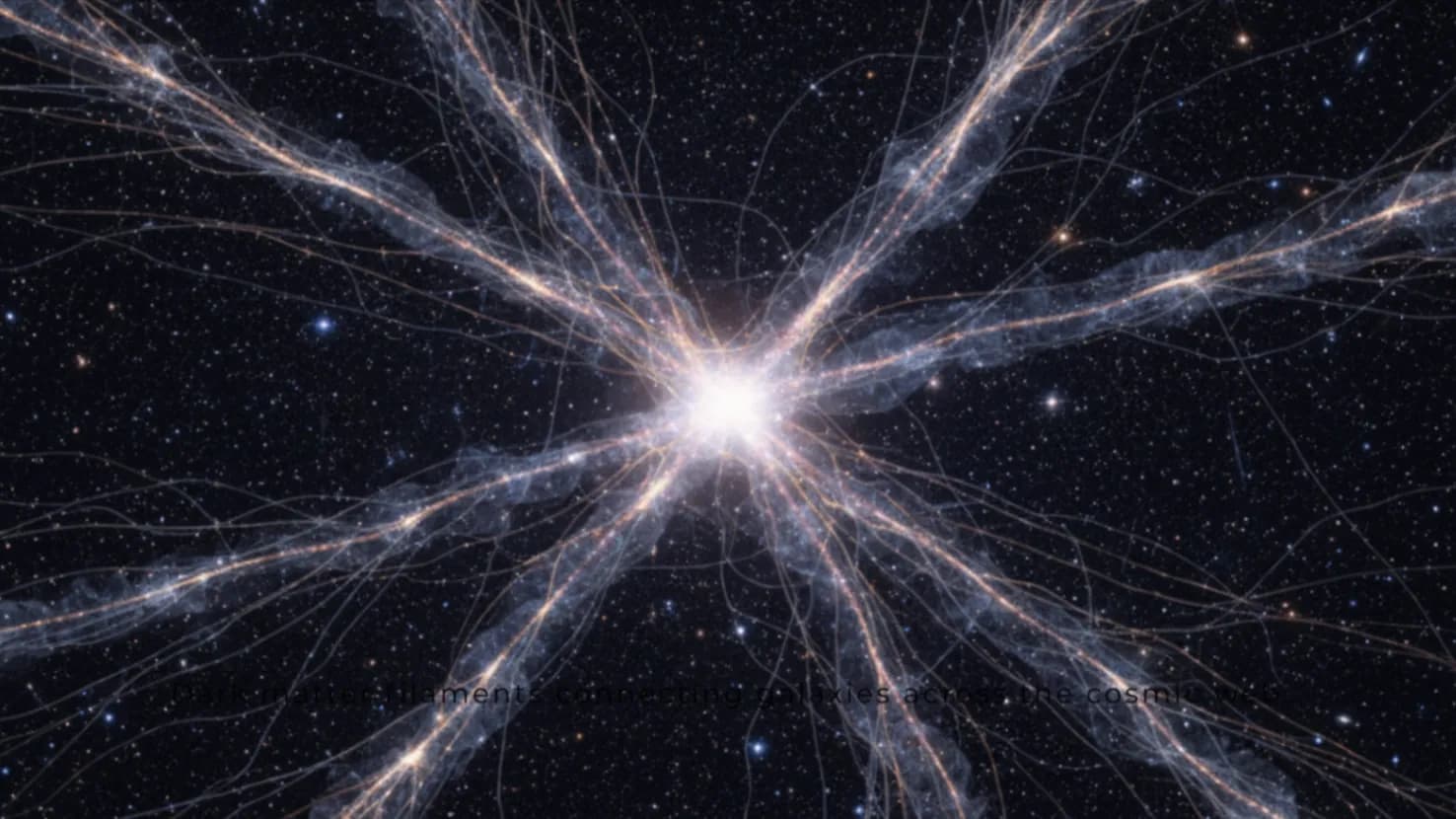
Dark matter filaments connecting galaxies across the cosmic web.
Dark matter is one of the biggest cosmic mysteries of our time. Even though we cannot see it, scientists are almost certain that it exists because the universe behaves as if a huge amount of invisible mass is present. Everything we see — stars, planets, galaxies, and all visible matter — makes up less than five percent of the universe. The rest is hidden, and a major part of that hidden universe is dark matter, a substance that neither glows nor absorbs light but has tremendous gravitational influence.
We know dark matter exists because of three key observations made over the past century:
• Galaxies rotate too fast:
Stars at the edges of galaxies move so quickly that they should fly off into space, but they don’t. Something unseen is providing the extra gravity needed to hold them in place.
• Light bends more than expected:
When light from distant galaxies passes near large clusters, it bends more strongly than what visible matter alone can explain. This effect, called gravitational lensing, indicates the presence of hidden mass.
• The universe’s large-scale structure needs it:
Computer simulations of the universe only match reality when dark matter is included. It acts like an invisible framework on which galaxies are built.
With strong evidence pointing to its existence, the natural question is: What is dark matter made of? Scientists have proposed several candidates, but three leading theories stand out.
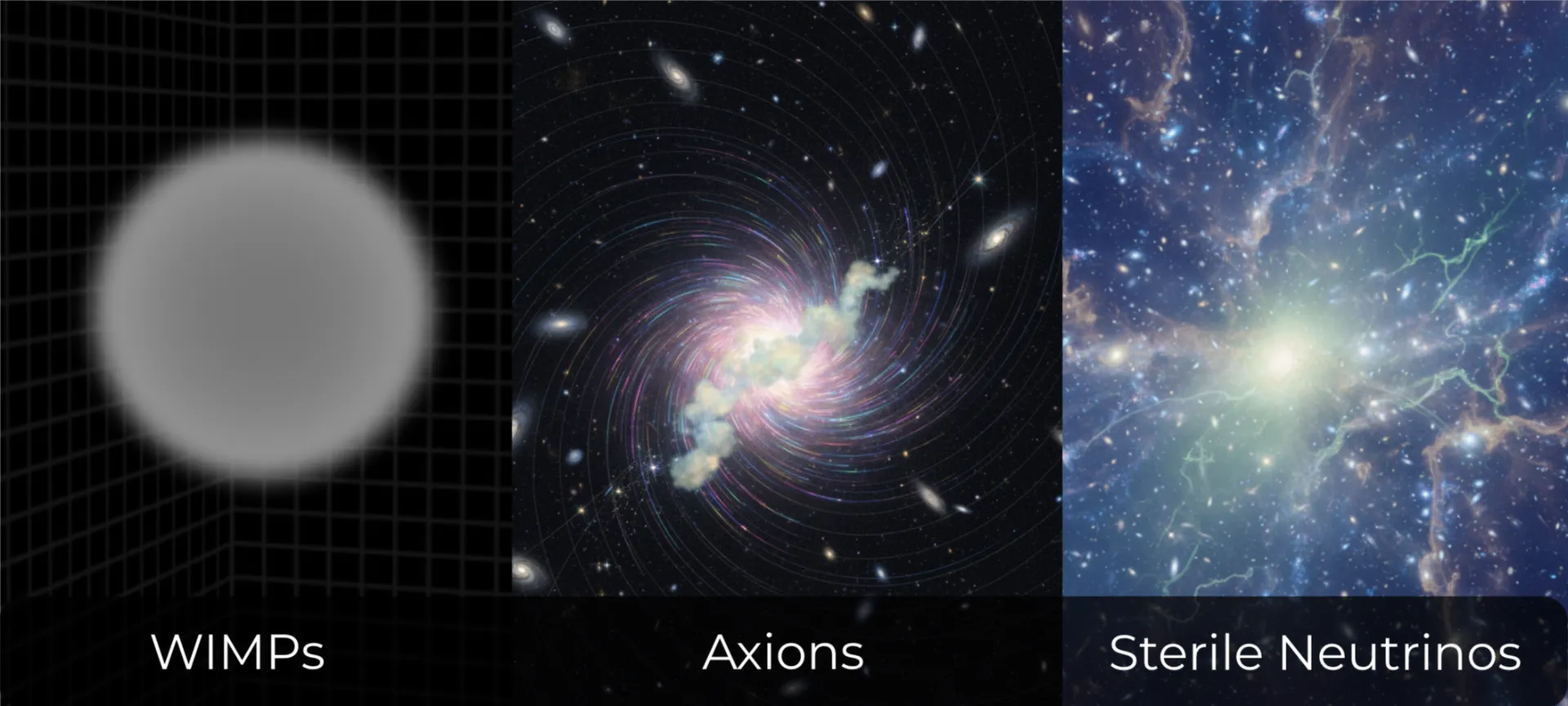
1. WIMPs — Weakly Interacting Massive Particles
WIMPs have been the most popular dark matter candidates for decades. They are theoretical particles that have mass but interact so weakly with normal matter that they pass through it unnoticed.
WIMPs are compelling because:
They would have formed naturally in the early universe.
Their predicted abundance matches the observed amount of dark matter.
They fit well into theories of physics beyond the Standard Model.
Experiments deep underground are attempting to detect the rare collisions between WIMPs and normal atoms. So far, none have been confirmed, but the search continues globally.
2. Axions — Ultra-Light, Wave-Like Particles
Axions are another strong possibility. Unlike WIMPs, axions are extremely light — a billion times lighter than electrons. They are predicted to behave more like waves spreading across the universe rather than individual particles.
Axions are exciting because:
They could form vast, invisible “axion clouds” around galaxies.
They interact so weakly that they could easily remain hidden.
They naturally solve certain physics problems unrelated to dark matter.
Scientists are designing experiments where axions might convert into faint photons inside strong magnetic fields. While hints have appeared, no direct evidence has yet been found.

3. Sterile Neutrinos — The Hidden Cousins
We already know about three kinds of neutrinos, which are tiny, fast-moving, and extremely difficult to detect. A sterile neutrino would be an even more elusive version — one that does not interact through any force except gravity.
Sterile neutrinos are compelling because:
They might explain strange patterns in how galaxies form.
They may be connected to mysterious X-ray signals seen in space.
They fit naturally into several advanced particle physics theories.
However, studies have shown mixed results, so scientists continue to investigate.
So, What Is Dark Matter Really Made Of?
The truth is that no one knows — yet. But that is what makes dark matter one of the most thrilling fields in modern science. We know it outweighs normal matter, shapes galaxies, and influences the evolution of the universe. What we don’t know is what type of particle — WIMPs, axions, sterile neutrinos, or something entirely new — is responsible for this invisible cosmic glue.
Researchers worldwide are building sensitive detectors, analyzing deep-space data, and running massive simulations to uncover the answer. When the true nature of dark matter is finally discovered, it may open the door to new physics and revolutionize our understanding of the universe.
Dark matter reminds us that the cosmos is full of mystery. Most of the universe is still unseen, waiting to be explored — and that sense of wonder is what drives astronomy forward.