Raktim Ranjit Advances Practical Business Software for Global Markets
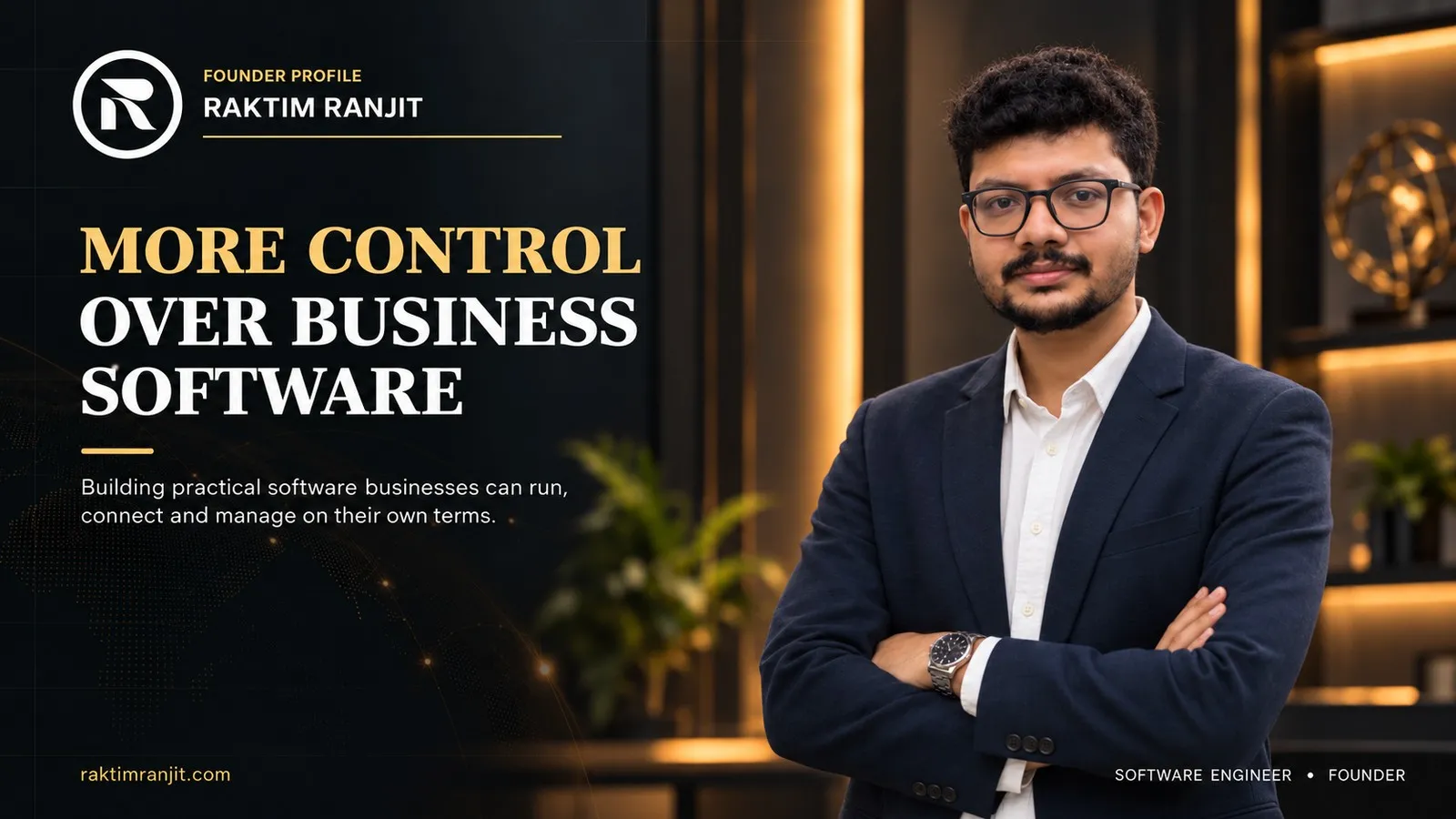
“India’s software builders should be able to create tools that work here and connect to the wider world. We are adding APIs and MCP to products where they solve a real problem, so businesses can link their own websites, operations and compatible AI tools without giving up control.”
— Raktim Ranjit, Founder of NodeDR Infotech
INDIA — October 29, 2026 — A restaurant order is never just a line on a screen. During a busy service, it must reach the kitchen, draw on stock, appear on the bill and become part of the day’s records. Software engineer and founder Raktim Ranjit builds around these connected steps.
Today, NodeDR Infotech presented its portfolio of business software for restaurants, retail, accounting, pharmacies, workforce operations and more, with products intended for businesses in India and international markets.
The Work Behind the Software
Ranjit’s products start from different jobs, but share a question: what must the system remember, and what needs to happen next? A restaurant needs the kitchen ticket to match the till; a retailer needs the receipt, stock movement and tax calculation to agree; a pharmacy needs to track batches and expiry dates. These everyday details decide whether a busy operation stays manageable.
Ranjit works across software interfaces, data models, APIs, security and deployment. He designs how a transaction moves through a business: who can record it, what changes when it is saved, how it can be corrected and how staff can trace it later. Public case studies explain the decisions and the current scope of each product.
A Restaurant Order, from Counter to Kitchen
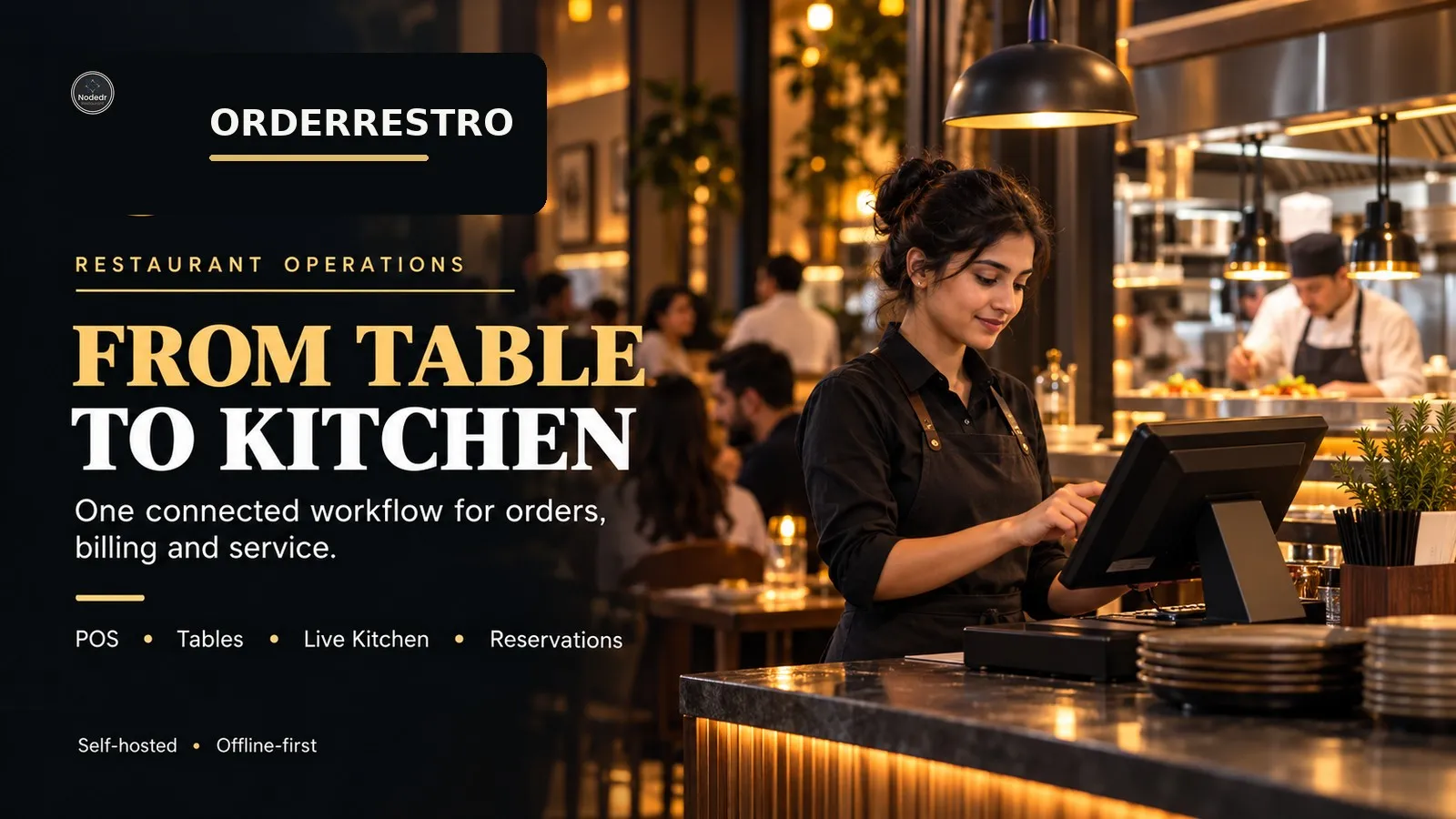
OrderRestro brings restaurant point-of-sale billing, tables, reservations, a kitchen display, inventory and customer loyalty into one self-hosted system. A server runs at the restaurant; tills, tablets and kitchen screens connect over the local network. That design lets order-taking and kitchen operations continue on the premises even if the internet connection drops.
For a restaurant team, the point is simple: the work already in motion should not stop because a connection elsewhere has failed. OrderRestro covers more than the counter transaction. Staff can manage dine-in, takeaway and delivery, send tickets to the kitchen, track tables, handle reservations and maintain customer profiles.
Recipe-based stock connects ingredients to sales, while staff permissions limit access by role. Restaurants can also configure QR ordering, reports, campaigns and other operating tools. NodeDR says OrderRestro is helping restaurant clients around the world.
Its configurable tax modes include India GST, U.S. sales tax, Spain IVA, EU VAT and custom regimes. Settings vary by location, so operators should confirm local rules; availability of a tax mode does not by itself establish compliance with every jurisdiction’s requirements.
Websites, APIs, and a Practical Path to AI
A restaurant may take orders at the counter, by phone and through its own website. If those channels send work into separate systems, staff must re-enter details and monitor several queues. OrderRestro’s integration API is designed to let a restaurant website send orders and bookings into the same operational flow, where they can appear for staff and the kitchen.
The aim is to reduce the gap between the customer-facing website and the work happening behind the counter. OrderRestro also includes an MCP server for compatible AI assistants. With a permission-scoped key, an assistant can use selected functions, such as checking the day’s orders or creating a booking, within the key owner’s permissions.
MCP access varies by product and AI system. Businesses often use software from several providers. Documented APIs and MCP interfaces can connect a website, internal tool or AI workflow without repeated data entry.
Ranjit documents the scope and permissions of these integrations.
From Invoice to Ledger
Rechvix—referred to by Ranjit as his most viral product—is an open-source platform for billing, inventory, accounting and business operations. It is designed for businesses that need one transaction to make sense across multiple records: an invoice, an inventory movement, a customer balance and the related accounting entries. Its double-entry ledger and document history are intended to make those changes traceable, rather than leave owners to reconcile disconnected records after the fact.
Published Rechvix tax workflows cover India, Spain, the United Kingdom and the United States, with distinct limits. India includes GST invoicing and accountant exports; e-invoice and e-way bill workflows need a configured provider. Spain IVA features are documented separately from certification or live-authority testing.
UK VAT calculations do not include Making Tax Digital submissions. U.S. support covers configured state base sales tax, not local tax, nexus advice or returns. The distinction matters because “tax support” may mean a calculation, accountant report, export file, provider connection or completed filing.
Rechvix’s documentation separates those tasks so businesses can see what is included and where a provider or professional review is needed.
Products for Different Kinds of Work
Ranjit’s products address different settings rather than forcing every business into one template. NodeDR POS focuses on retail checkout, inventory, customer credit and GST-aware receipts, including offline use. KinetiRx supports pharmacy and clinic workflows such as medicine billing, batch and expiry tracking, patient records and scheduling.
Zulivio brings employee records, attendance, assignments and a sales pipeline into workforce operations. Submify gives developers a form backend they can run themselves, receiving website submissions through an API and storing them in their own database. NodeDR Construction ERP follows materials from site requests and approvals through purchasing and use, tied to milestones and budgets.
Mavri provides self-hosted invoices and quotes with a REST API, signed webhooks and structured exports. The products share a need for reliable records, but restaurant service, retail checkout, pharmacy stock and construction procurement do not share one workflow. Keeping them distinct lets each system account for its own details.
Each focuses on a specific practical job. Ranjit’s project pages describe the products alongside their architecture, security boundaries and trade-offs. Business owners can review what a system does; developers can inspect its implementation where source code is public.
Self-Hosting, Control, and Choice
Several NodeDR products can run on infrastructure a business controls. For a restaurant, a local server can keep the till and kitchen working on the same network. For other organizations, self-hosting offers a choice about where records live and how access and backups are managed.
It also makes the operator responsible for updates, security and recovery. Self-hosting can coexist with integrations. A business can control its installation and connect a website or compatible AI assistant, while deciding what data moves and which actions are allowed.
Ranjit treats APIs and MCP as permissioned interfaces, not blanket access to business records.
Built in India, Open to the World
Ranjit’s ambition is to build software from India for businesses wherever they operate. Selected products include multiple tax-region settings, APIs and integrations for compatible AI tools; NodeDR also reports international use of OrderRestro. These capabilities support broader reach, while availability and compliance still depend on each product and market.
Starting from India also means treating a market as many realities: languages, payment habits, connectivity and local regulations can shape daily software use. Building for those realities can produce systems that are easier to adapt elsewhere, provided each market’s rules are verified. NodeDR’s stated direction is to keep local workflows clear while leaving room for international configuration and integrations.
Businesses are adding online ordering, digital records, automation and AI to work that already has to happen on time. Software helps when it connects those activities and reduces repeated entry. A website order should reach the kitchen; a retail sale should update stock; an operations team may want an assistant to prepare a report.
Useful systems start with those real tasks. For India’s growing AI ecosystem, documented integrations can help local software connect to a wider set of tools. MCP gives compatible assistants a way to use selected product functions; APIs support websites and services.
Businesses choose where AI saves time while retaining control. Product documentation identifies supported connections.
A Founder’s View of Progress
For Ranjit, changing the world begins with making ordinary work less fragmented. Businesses need dependable software that understands invoices, kitchen tickets, stock counts and staff permissions. Accurate records and systems that can communicate with other tools give them a stronger foundation for automation and new services.
The portfolio is Ranjit’s attempt to build that foundation across several industries. Product pages describe current capabilities and limits, while case studies show the decisions behind them. Customers and developers can use that public record to judge whether a product fits their needs and where it can improve.
NodeDR Infotech plans to keep building for businesses in India and international markets, with practical workflows, deployment choices and integrations where useful. Ranjit’s view is that software shaped by local operations can still be open to the world. His portfolio applies that idea across restaurants, retail, pharmacy, accounting, construction and website infrastructure.
Readers can explore Raktim Ranjit’s official website, the project case studies and the OrderRestro case study for product details, implementation decisions and links to available documentation and source code. Clients exploring workflow or integration options can contact Raktim Ranjit at [email protected]; public project portfolio offers useful context.
Ranjit says NodeDR Infotech has developed websites for hundreds of businesses in the United States and served clients in more than 13 countries. That client work brings its software and web development experience to organizations beyond its own product portfolio.
About NodeDR Infotech Private Limited
NodeDR Infotech Private Limited is an India-founded software company led by software engineer and product builder Raktim Ranjit. The company develops business applications for restaurants, retail, accounting, pharmacies, workforce teams, construction operations and web infrastructure, serving organizations in India and international markets. Its portfolio includes OrderRestro, a self-hosted restaurant point-of-sale and operations platform; Rechvix, an open-source system for billing, inventory, accounting and business management; NodeDR POS for retail; KinetiRx for pharmacy and clinic workflows; Zulivio for workforce operations; NodeDR Construction ERP; Submify, a self-hosted form backend; and Mavri for invoices and quotes. The products focus on practical work: routing orders to kitchens, updating stock, recording invoices, managing staff and keeping business records traceable. Several can be deployed on infrastructure their operators control. APIs, webhooks and Model Context Protocol (MCP) integrations are available where documented. Features vary by application and market. Tax tools have defined scopes and do not by themselves guarantee regulatory compliance, filings or certification. NodeDR Infotech has also developed websites for hundreds of businesses in the United States and served clients in more than 13 countries, extending its work into custom web projects alongside its product portfolio. NodeDR Infotech builds from India for businesses and developers worldwide. Its product pages and case studies describe current capabilities, deployment options, technical architecture and limitations, helping readers assess whether a product fits their workflows.