Best Stargazing Places in India for Winter 2026–27: A Night-Sky Guide
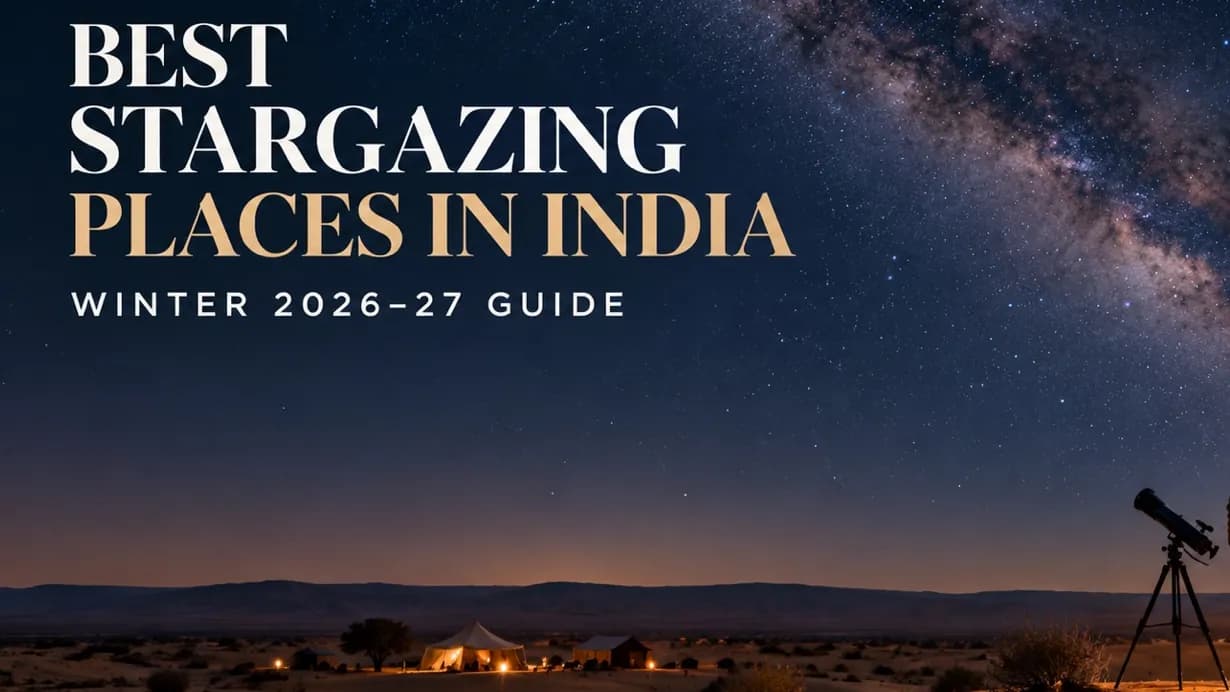
India’s winter sky can be surprisingly rewarding- all you have to do is move away from the citylights, choose a relatively clear night and resist the temptation to plan everything around a full moon.
From Rajasthan’s open desert landscapes to organised observatory visits in Uttarakhand and Tamil Nadu, there are several ways to experience the night sky without travelling to an inaccessible Himalayan outpost. Some locations are suitable for a relaxed family trip; others require advance permission, careful planning or an experienced local guide.
Here are some of the best places to consider for stargazing in India during winter 2026–27.
1. Sam Sand Dunes near Jaisalmer, Rajasthan
The open landscape outside Jaisalmer is one of India’s most approachable settings for a winter night under the stars. The official Incredible India page for Sam Sand Dunes specifically lists stargazing among the experiences available in the area.
November to February usually brings more comfortable desert temperatures than the summer months. However, the busiest camp clusters can be surprisingly bright and noisy. If the sky is your main reason for visiting, ask your camp or authorised local operator whether they can arrange a safe viewing spot away from floodlights and loud entertainment areas.

Carry warm layers: desert temperatures can fall sharply after sunset.
Best suited for: First-time stargazers, couples and families combining astronomy with a Rajasthan holiday.
2. Sambhar Lake, Rajasthan
The enormous open landscape surrounding Sambhar Lake creates broad, unobstructed views of the horizon. Incredible India describes the salt-lake setting as suitable for stargazing and notes that winter also attracts migratory birds.
Sambhar is relatively accessible from Jaipur, making it an option for travellers who do not want to build an entire holiday around an overnight desert camp. However, visitors should not drive onto unfamiliar sections of the lakebed. Conditions can change, and some areas may be used for salt production or subject to local restrictions.
Visit with a responsible local operator, remain on permitted routes and avoid disturbing birds or other wildlife.
Best suited for: Travellers from Jaipur seeking a short winter escape with photography and stargazing.
3. Great Rann of Kutch, Gujarat
Few landscapes feel as open as the White Rann. The official Rann Utsav page highlights the region’s clear desert sky and stargazing experiences. The 2026–27 festival season is listed from October 2026 to February 2027.
There is one important distinction: a full-moon night may make the salt desert look spectacular, but it is not necessarily the best night for seeing faint stars. Moonlight brightens the sky and reduces contrast. Travellers interested primarily in astronomy should consider dates closer to a new moon and choose accommodation or viewing areas away from the brightest festival lighting.
Entry requirements and permitted routes can change because parts of Kutch are close to sensitive border areas. Check current instructions and carry valid identification.
Best suited for: Travellers looking for a cultural holiday that also includes a night-sky experience.
4. Bhandardara and the Kalsubai Region, Maharashtra
For residents of Mumbai, Pune and Nashik, the Bhandardara–Kalsubai region is among the more convenient options for a stargazing weekend.
The Maharashtra Tourism Department identifies December to February as a period of clearer skies and specifically mentions photography and stargazing in the wider Kalsubai area. Bhandardara Lake and the surrounding Sahyadri landscape also support several camping experiences.
Convenience has brought crowds, particularly on weekends. Before booking, check whether the campsite uses bright decorative lighting or plays music through the night. A quieter, responsibly operated campsite can make a much bigger difference than expensive equipment.
The summit trek should not be attempted at night without an experienced guide. You do not need to climb Kalsubai simply to see the stars.
Best suited for: Weekend travellers and beginners from western India.
5. ARIES, Manora Peak, Nainital
Travellers who want more than an attractive night sky can apply for a public visit to the Aryabhatta Research Institute of Observational Sciences, or ARIES, at Manora Peak.
According to the institute’s official visitor information, night sky-watching is available after sunset, subject to clear conditions. Visitors should submit a request in advance. The public programme may also include the science centre, planetarium material and telescope-based observations, depending on the approved visit.
Winter in Nainital can bring cold conditions, fog or cloud, so telescope viewing can never be guaranteed. Treat the observatory visit as an educational experience rather than a promise that every celestial object will be visible.
Best suited for: Students, families and travellers who want a guided astronomy experience.
6. Vainu Bappu Observatory, Kavalur, Tamil Nadu
The Vainu Bappu Observatory offers one of the clearest official routes to an organised astronomy visit in southern India.
The Indian Institute of Astrophysics states that the observatory is open to the public on Saturdays, generally from 2 pm to 9 pm. If weather permits, visitors can participate in an evening sky-observation programme using smaller public-viewing telescopes and binoculars.
The observatory houses major research facilities, but visitors should not assume that every research telescope will be available for public viewing. Check the current schedule, entry arrangements and weather before making the journey to Kavalur.
Best suited for: Astronomy enthusiasts, students and families travelling from Bengaluru or Chennai.
What About Hanle and Spiti?
Hanle in Ladakh is one of India’s most important dark-sky destinations. It is home to the Indian Astronomical Observatory, while the surrounding area has been developed as the Hanle Dark Sky Reserve. Ladakh’s administration has also trained local astronomy ambassadors and introduced measures intended to protect the night sky.
However, the official Ladakh Tourism guidance recommends approximately April to October for clearer skies and more practical travel conditions. Hanle should therefore not be treated as a casual December-to-February recommendation. Extreme cold, altitude and seasonal road conditions require serious preparation.
The same caution applies to Spiti. Its high-altitude landscape offers star-filled skies, but winter travel can involve severe cold, limited services and disrupted roads. These destinations are better planned as specialised journeys—not spontaneous stargazing weekends.
How to Choose the Right Night
A good location can still produce a disappointing experience if the timing is wrong.
Choose a night close to the new moon if you want to see more stars.
Check the cloud forecast, visibility and local weather before leaving.
Arrive before sunset so that you can understand the surroundings safely.
Allow your eyes around 20 to 30 minutes to adjust to the darkness.
Use a dim red light instead of a bright phone torch.
Avoid shining lights towards other observers or telescopes.
Confirm local permissions before entering deserts, forest areas, lakebeds or protected land.
A telescope is optional. A basic pair of binoculars, a reclining chair and a recognised sky-map application can be enough for a memorable first experience.
What to Carry for Winter Stargazing
Pack for sitting still in the cold rather than for the daytime temperature.
Carry layered clothing, a warm cap, gloves, closed shoes, drinking water, basic medicines, a charged power bank and a small red-light torch. If you are photographing the sky, bring a stable tripod and spare batteries, as cold weather can reduce battery performance.
Avoid wandering away from your group in darkness. In remote areas, use an experienced local guide and share your travel plan with someone you trust.
Look Up, But Travel Responsibly
Stargazing works best when the surroundings remain dark, quiet and undisturbed. Keep music low, carry your waste back, do not point lasers at the sky and avoid disturbing wildlife or nearby communities.
India’s night skies do not always require a difficult expedition. Sometimes the better experience is simply a carefully chosen new-moon weekend, a responsible local stay and enough patience to let the darkness settle.
Disclaimer: Access rules, observatory programmes, weather conditions, road status and local permissions may change. Verify details with the relevant authority or destination before travelling. Night-sky visibility is weather-dependent and cannot be guaranteed.