THE GEOPOLITICS OF AN EMPTY PLATE
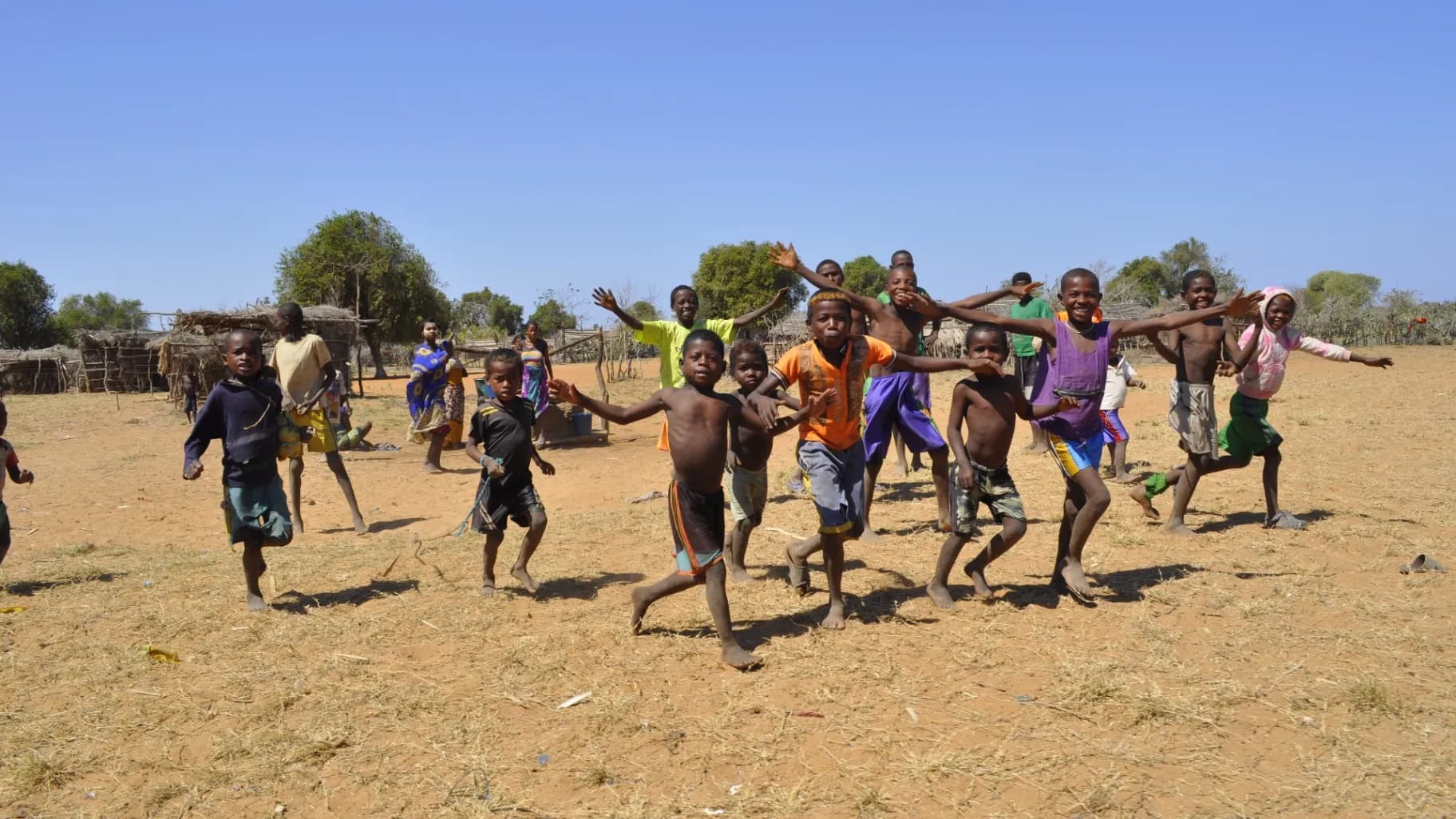
Photo: Children in Itampolo, Madagascar by1 Mada261 (Source: Wikimedia Commons, Licensed under CC BY-SA 4.0). Note: The children pictured are illustrative and not individually identified in the text.
Marolaza Soa was ten years old and lived in southern Madagascar, where years of drought had destroyed crops and household incomes. In southern Madagascar, farming was an important source of food and income, but the drought destroyed crops and made it increasingly difficult for families to earn enough to eat. By the time UNICEF met Marolaza, even one meal a day was a struggle. At 2:40 p.m. she was eating her lunch which also happened to be her breakfast. She ate Rice and Cassava leaves. That meal contained no protein, even though it is essential for a growing child's body and brain. Sometimes the condition was so severe that she would go to bed hungry.
The drought was making life hard for the whole family. Marolaza's mother was trying to keep both children in school while also finding enough money to buy food. She sold charcoal to help feed her family, but this meant cutting down trees which could harm the environment and the future generations. Aid workers gave her family some food including oil, peas and beans. But this food could only help her for a short period of time. Marolaza is not just a number. She is a child who had to eat the same food for breakfast and lunch because her family had very little or no food at all. Her story shows how climate change can lead to hunger, problems in education and struggle for basic necessities.
Harvest is massive, the insecurity is fatal
The Food and Agriculture Organization (FAO) estimates that around 645 million people faced hunger in 2025, which is about 7.8 percent of the world's population. At the same time, approximately 2.1 billion people experienced moderate to severe food insecurity, which means that they could not find access to safe and nutritious food. If the world produces enough food to feed its population, then why do so many people still go hungry? The problem is not always a lack of food. It is whether people can afford it, reach it and get it safely. This is the case in Haiti.
Hunger is spreading through one of the country's most fertile regions. The Artibonite Valley is known as Haiti's breadbasket because it produces much of the country's rice. But in 2023 and 2024, armed violence increasingly disrupted farming there. Farmers were forced to abandon their land, their crops were stolen and the roads that were used for transporting food became dangerous.
One of them was Augustin, a 42-year-old rice farmer who had spent his life cultivating land. In May 2023, when it was time to harvest his crops, armed men stole everything he had grown. He had to flee for his life. After spending months growing food he could not use his own harvest to feed his family. The problem affected many more people than just the farmers. By March 2024, nearly 5 million people in Haiti were facing serious food shortages according to the Integrated Food Security Phase Classification (IPC) . Violence, high prices and poor harvests made the situation worse. The price of basic food increased by 22 percent between August 2023 and February 2024. In parts of the Artibonite Valley, armed groups also took over farms and stole crops.
Having food is not always enough to stop hunger. Farmers can grow food but people can still go hungry if farmers cannot reach their fields, their crops are stolen or roads are unsafe.
What poverty actually destroys
The World Bank's international poverty line is now $3.00 a day under the 2021 PPPs. South Sudan shows how poverty can become much worse when people have no source to depend upon. Around 76 percent of the population lived below the national poverty line in 2024 according to the World Bank assessments, More than two-thirds were also living in extreme poverty.
For most of the families, poverty is not just about having little money. It also means having no savings or financial support. A flood can destroy crops, skyrocketing food prices can make meals unaffordable, and conflicts can make families leave their homes. In poverty, even one crisis can make their situation worse. In all these conflicts, children are the most affected. In 2024, more than 1.6 million children under five were suffering from acute malnutrition. Millions were already facing food insecurity. These conflicts make it difficult for people to afford food.
South Sudan heavily depends on farming, but farmers often struggle to grow and sell their crops. Floods can destroy farmlands, while conflicts stop farmers from reaching their own fields. Damaged roads make transporting food harder and expensive. This creates a difficult vicious cycle. Poor have very limited resources to deal with these types of crises, and each new crisis can make their life harder. South Sudan shows how poverty can get worse when people have no support at all.
The inseparable bond between Hunger and Sickness
Malnutrition and disease are closely connected. A child who does not get a, balanced diet becomes weaker and is more likely to get sick. At the same time illness makes it difficult for a child to eat and keep in the nutrients in their body. This creates a cycle where hunger and sickness make each other worse.
Haiti shows this clearly. In 2023, food shortages, violence and cholera were putting many children in risk. UNICEF estimated that more than 115,600 children would suffer from severe wasting that year, which was about 30 percent more than 2022. More than 41,000 suspected cholera cases were also reported with children under 14 making nearly half of them.
The situation became worse because many people could not get medical help. In the Artibonite region, violence made it hard for families to travel, making health centers inaccessible for them. Simultaneously, hundreds of thousands of people were struggling to get enough food. Haiti showed that hunger, disease and poor healthcare cannot always be separated.
What proven solutions teach us
The solutions to hunger are already known. The real challenge is making governments and societies act on them.
Ethiopia has shown that fighting hunger is not only about giving during a crisis. Its Productive Safety Net Programme, started in 2005, gave poor families regular food or cash support. People who could work also helped with improving farms and building roads.
The programme helped families survive difficult times without selling important things like livestock. It also helped communities to prepare for drought and food shortages. The programme has not ended hunger or poverty, but it shows that emergency food aid alone is not enough. Families also need income and other kinds of support.
The politics of Neglect
In 2025, the world spent about $2.9 trillion on military spending, according to SIPRI . For 2026, the World Food Programme estimates that it would need $13 billion to provide food and other support to 110 million of the world's most vulnerable people. The world has the resources to fight hunger. The bigger question is whether we choose to use them where they are needed most.

People survived because they received support through a programme like Ethiopia's Productive Safety Net Programme. That support helped their family get through a difficult period without losing everything they depended upon. But many families across the globe that are facing the same problem still do not receive any support.
We already know many ways to fight hunger like school meals, cash support, clean water and healthcare. The problem is making sure these solutions reach the people who need them. Hunger can be reduced. We already know what works. The real challenge is turning that knowledge into action.