How I Improved the Appearance of My Hair Density: My Personal Routine After COVID
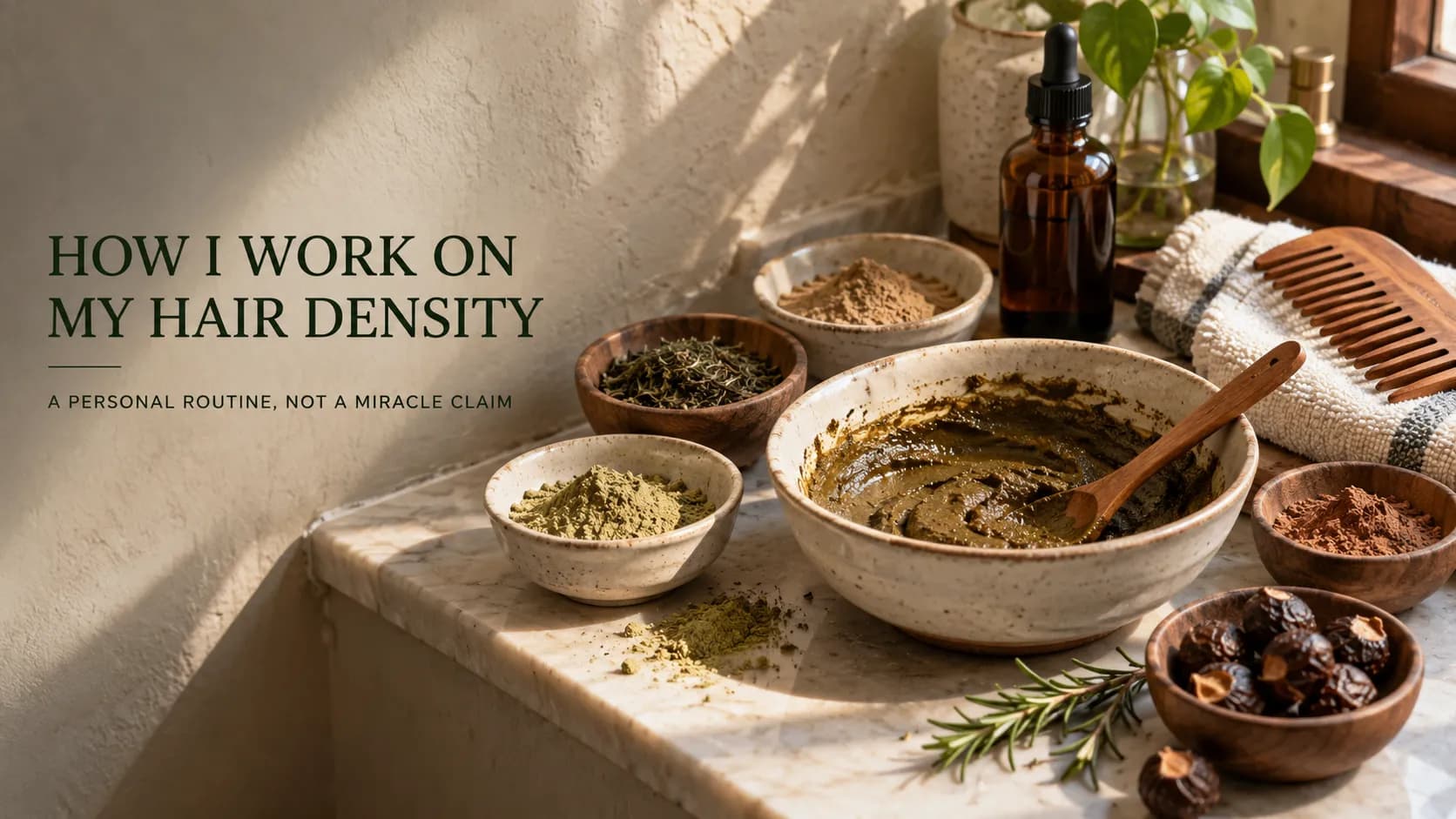
Hair Mask and Hair Serums for Hair Growth · Image: Hair Serum
I grew up with thick, healthy hair. Hair density was never something I had to think about- until it suddenly was.
After COVID, my hair became noticeably finer. I had also moved cities and now live in Delhi. Changes in health, water, routine, stress and the environment may all have played a part, although I cannot establish which factor caused what.
More than a year later, my hair routine is less about searching for one miracle bottle and more about supporting my scalp, reducing unnecessary damage and staying consistent. I have tried The Ordinary, Minimalist, WishCare, Be Bodywise, ThriveCo and other popular products. Peptide serums have helped me see some baby-hair growth and a modest improvement in the appearance of density.
What they have not done is magically turn every new strand into thick, mature hair. Growing and maintaining those fine new strands appears to require more than serum alone.
I Moved Away From Heavily Fragranced Haircare
One of my first changes was moving away from strongly perfumed shampoos and products that left my scalp or hair feeling stripped.
I am not claiming that every fragranced product causes hair loss. I simply found that a gentler routine suited me better. My focus shifted from making my hair smell good for hours to keeping my scalp comfortable and reducing breakage along the lengths. The American Academy of Dermatology also recommends gentle shampoo and conditioning for thinning or fragile hair because damaged strands can break more easily.
The Herbal Mask I Use Before Almost Every Wash
I wash my hair approximately once every three days. Before most washes, I prepare a herbal mask containing:
one tablespoon of amla powder;
one tablespoon of bhringraj powder;
one tablespoon of shikakai powder;
one tablespoon of reetha powder;
curd;
a small amount of milk;
a little honey; and
a small amount of coffee powder.
I add enough curd to form the base, then use milk and water to adjust the consistency. I prepare the mixture the previous evening and allow the powders to hydrate. Any mixture containing dairy should be kept covered and refrigerated rather than left at room temperature overnight.
By the next morning, the mask becomes darker and thicker. I add a little water if necessary so that it can be distributed without pulling at my hair.
Before applying it, I gently comb through my hair and remove tangles. This makes application easier and reduces unnecessary tugging. I leave the mask on for at least 15 minutes; when I have time, I keep it for approximately an hour. I do not leave it on my scalp overnight.
I then rinse it thoroughly. If my scalp still feels coated, I use a mild commercially formulated reetha, amla or shikakai shampoo to remove the residue.
For me, this routine makes my hair feel soft and smooth. I do not present the mask as a clinically proven treatment for hair regrowth. Its most immediate benefit in my experience has been manageability, softness and reduced roughness. Anyone with a sensitive scalp should patch-test the mixture first. Stop using it if it causes itching, burning or persistent irritation.
I Oil Only Shortly Before Washing
I still use hair oil, but I do not leave a heavy layer on for hours or days.
Around 15 to 20 minutes before shampooing, I apply a small amount of carrier oil containing one or two drops of rosemary essential oil. Essential oil should not be applied directly to the scalp without dilution. This step mainly helps me with pre-wash conditioning. I would not describe a few drops of rosemary oil as a substitute for diagnosing persistent hair loss.
The Serum That Worked Best for Me
Of the cosmetic serums I have tried, The Ordinary Multi-Peptide Serum for Hair Density remains my preferred option. Its formula contains several peptide and plant-extract technologies, including Redensyl, Procapil, Capixyl, Baicapil and AnaGain, along with caffeine.
After consistent use, I noticed baby hairs and some improvement in the appearance of density. The limitation is equally important: much of the new growth remained fine. The serum appeared to help at the beginning of the process, but maintaining those hairs and improving their thickness was not something one bottle achieved on its own.
The brand describes the product as improving the appearance of thickness and fullness. It does not present it as a cure for every form of hair loss. Its official directions recommend applying a few drops to a clean, dry scalp once daily.
A Short Comparison With the Other Serums I Used
I do not think every serum I tried deserves a separate recommendation. Here is the shorter, honest comparison.
The Ordinary Multi-Peptide Serum: This gave me the clearest personal result—mainly baby hairs and a modest density improvement. It remains my first choice, although the new strands were still fine.
Be Bodywise roll-on: The applicator makes targeted use easy, but I found that the roll-on format could dispense more product than I realised. The roll-on was used faster than expected.
WishCare spray: I had a similar problem with consumption. The micro-spray was convenient, but my bottles seemed to empty quickly because it was easy to keep spraying across the scalp.
Minimalist Hair Growth Actives: I personally did not see a meaningful result. That does not prove that the formula cannot work for someone else; it simply did not distinguish itself in my routine.
ThriveCo Hair Growth Serum: I used it, but nothing seemed to work enough.
Dermatouch Actives 2% Rosemary Water: I am currently using this lightweight spray. It contains rosemary water alongside ingredients such as AnaGain, Procapil and Redensyl. I have not used it long enough to give a final verdict.
These are personal observations, not controlled comparisons. I used the products at different times and alongside other parts of my routine.
An Important Note About My Derma Stamp

I have used a sanitised derma stamp before applying scalp serum. In practice, I have sometimes applied the serum immediately afterwards, although advice I encountered suggested waiting 10–15 minutes.
After checking the product directions and dermatology guidance, I would not recommend readers copy that sequence without speaking to a dermatologist.
The Ordinary specifically says its serum should be used only on unbroken skin. Microneedling or derma stamping creates microchannels, so waiting 10–15 minutes does not necessarily make an ordinary cosmetic serum appropriate for freshly stamped skin.
The American Academy of Dermatology says some studies have found benefits from microneedling as part of medically planned hair-loss treatment. However, it also warns that home microneedling can cause infection, irritation, scarring and changes in skin colour when performed incorrectly.
This is the part of my personal routine that requires the most caution. Device choice, needle depth, frequency, sanitisation and aftercare should come from a qualified dermatologist- not an online routine.
The Dry Shampoo I Actually Like
Dry shampoo does not grow hair, but it can make managing fine hair easier between wash days.
Of the options I have tried, Anomaly Dry Shampoo , from the haircare brand founded by Priyanka Chopra Jonas, has been one of the better ones. It feels more usable to me than several loose powder formulas I tried, which left visible residue or made my hair feel unpleasant.
I use dry shampoo as a convenience product- not as a replacement for washing my scalp. The American Academy of Dermatology explains that dry shampoo absorbs oil but does not remove accumulated skin cells, microorganisms and product residue. It recommends washing with shampoo and water after one or two dry-shampoo uses.
What Has Actually Made the Difference?
I do not think one product restored my childhood hair.
What helped was a combination of consistency, gentler cleansing, conditioning the lengths, avoiding unnecessary product overload, using a peptide serum and paying closer attention to how my scalp responded.
The Ordinary has been the most useful cosmetic serum in my experience, but its result was limited: baby hairs and some visible density, not instant thick growth.
That distinction matters. Fine new growth is encouraging, but keeping those strands healthy requires time, gentle handling and, where thinning continues, professional assessment.
Personal-experience and health disclaimer: This article describes one writer’s routine and results. It is not medical advice, and no product or home mixture is guaranteed to produce hair growth. Persistent, sudden or patchy hair loss should be assessed by a qualified dermatologist. Product formulations and directions were checked on 11 October 2026 and may change.