How to Report Cyber Fraud in India: 1930 Helpline, Online Complaint and Next Steps
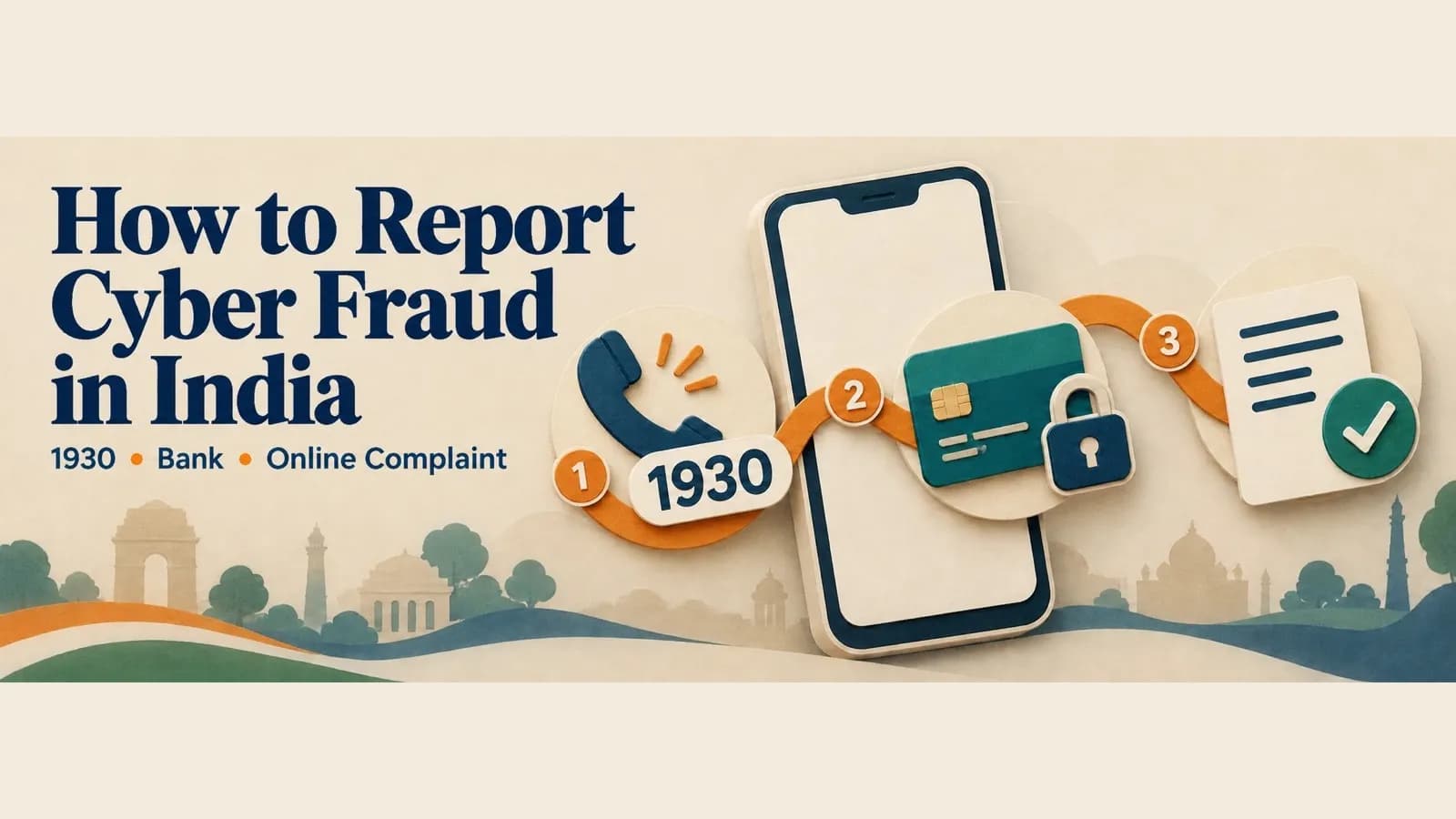
Victims of financial cyber fraud should contact their bank, call 1930 and register the incident on the National Cyber Crime Reporting Portal as quickly as possible.
If money has been taken through an online scam, call India’s cybercrime helpline 1930, contact your bank or payment provider immediately, and register the incident at cybercrime.gov.in. Acting quickly may help authorities and financial institutions trace or restrict the movement of funds, but reporting does not guarantee recovery.
A fraudulent transaction can leave you unsure about what to do first. Should you call the bank, contact the police or file an online complaint? The answer is usually to do all three—but in the right order and without losing time.
If Money Has Been Lost, Do These Three Things First
1. Call 1930 immediately
The 1930 helpline is India’s national number for reporting financial cyber fraud. It operates through the Citizen Financial Cyber Fraud Reporting and Management System under the Indian Cyber Crime Coordination Centre.
Keep the following information ready:
the mobile number linked to your account;
the name of your bank, payment wallet or merchant;
the account number, wallet ID or UPI ID from which money was debited;
the transaction ID;
the date, time and amount of the transaction;
the recipient’s account or UPI details, if visible;
screenshots of the payment and related communication.
Provide accurate information. If you are uncertain about a detail, say so instead of guessing.
You may receive an acknowledgement or reference number after reporting the incident. Save it carefully and follow any instructions sent to you for completing the complaint on the National Cyber Crime Reporting Portal.
2. Notify your bank or payment provider
Call the bank using the official number printed on your card, listed inside its verified mobile application or published on its official website. Do not use a number sent by the suspected fraudster or found in an unverified search result.
Ask the bank to:
record the transaction as suspected fraud;
block or secure the affected card, account or payment facility;
prevent additional unauthorised transactions where possible;
provide a complaint or service-request number;
explain what supporting documents are required.
The Reserve Bank of India’s customer-protection directions advise customers to report unauthorised electronic transactions at the earliest. A delay may increase the risk of further loss and can affect how customer liability is assessed.
However, an important distinction applies. RBI protections for unauthorised electronic transactions do not automatically mean that every payment made after deception will be refunded. Liability and recovery can depend on how the transaction occurred, whether credentials were shared, how quickly it was reported and the applicable bank policy.
3. File the complaint at cybercrime.gov.in
Go directly to the official National Cyber Crime Reporting Portal. Avoid websites or people claiming that they can recover your money for an upfront fee.
Select the reporting option that best matches the incident and provide a clear account of what happened. Include:
how the fraudster first contacted you;
the phone number, email address, website or social-media profile used;
what the person claimed;
any link or application they asked you to open;
what information you shared;
how and when money was transferred;
every relevant transaction reference.
Upload the available evidence and save the acknowledgement number generated by the portal. Complaints submitted through the national portal are handled by the appropriate State or Union Territory law-enforcement agency.
What Evidence Should You Preserve?
Do not delete the conversation simply because it is upsetting or embarrassing. Even a message that appears unimportant may help connect the incident to a phone number, account or digital identity.
Preserve:
screenshots and chat exports;
SMS messages and emails;
phone numbers and call logs;
profile names and profile links;
website addresses;
QR codes and payment requests;
transaction receipts;
UPI IDs, bank-account details and wallet IDs;
fake invoices, identity cards or arrest warrants;
downloaded applications or file names;
the date and approximate time of each interaction;
complaint numbers issued by the bank, 1930 or the portal.
Keep original files wherever possible. Repeatedly forwarding or editing screenshots may remove useful information.
If the scam involved a supposed police case, courier parcel or “digital arrest”, read India News Grid’s guide to how digital arrest scams work and what to do when you receive such a call.
What If You Shared a Password, OTP or Card Detail?
Inform the affected bank or service provider immediately.
From a device you believe is secure:
change the compromised password;
use a new password that is not reused elsewhere;
sign out of unknown or active sessions;
enable two-factor authentication where available;
block the affected card or payment facility;
review recent transactions and account changes.

If you installed a screen-sharing or remote-access application at the fraudster’s request, disconnect the device from the internet and avoid using it for banking until it has been checked. Change sensitive passwords from a different, trusted device.
Do not share another OTP or make a second payment because someone promises to reverse the first transaction. Fraudsters sometimes contact victims again while pretending to be investigators, bank employees or recovery agents.
Financial Fraud and Other Cybercrime Are Not the Same Report
Calling 1930 is particularly important when money has been lost through an online financial fraud.
The National Cyber Crime Reporting Portal can also be used for other forms of cybercrime, including account compromise, impersonation, online abuse and certain social-media or digital offences. Choose the category that most accurately reflects the incident and provide evidence relevant to it.
For an immediate threat to personal safety, do not rely only on an online submission. Contact the local police or the appropriate emergency service.
When Should You Use Chakshu?
The Chakshu facility on the Department of Telecommunications’ Sanchar Saathi portal allows people to report suspected fraudulent calls, SMS messages and WhatsApp communications.
It is useful when you receive a suspicious communication involving matters such as:
fake KYC updates;
SIM deactivation threats;
impersonation of government officials;
fraudulent banking or wallet messages;
suspicious prize or payment claims;
threats or extortion attempts.
Chakshu is primarily a facility for reporting suspicious communications and the misuse of telecom resources. If you have already lost money or become a victim of cybercrime, use 1930 and cybercrime.gov.in instead of relying only on a Chakshu submission.
Does an Online Complaint Automatically Become an FIR?
Submitting information on the National Cyber Crime Reporting Portal creates an official cybercrime complaint, but it should not be described as an automatic FIR in every case.
The Ministry of Home Affairs states that complaints, their conversion into FIRs and subsequent action are handled by the relevant State or Union Territory law-enforcement agencies under applicable law.
Save your acknowledgement number and track the complaint through the available portal facility. If additional information is requested, provide it promptly. You may also approach your local police or cybercrime police station, particularly when the matter involves substantial financial loss, threats, identity theft or continuing harm.
Beware of Cyber-Fraud Recovery Scams
After a fraud, victims sometimes search publicly for help and receive messages from people claiming to be hackers, agents, lawyers or government contacts who can recover the money.
Be cautious if someone:
guarantees full recovery;
demands an advance payment;
asks for remote access to your device;
requests banking credentials or an OTP;
claims to have a personal contact inside a bank or police department;
asks you to communicate only through a private messaging application.
Use official reporting routes. No genuine complaint requires you to disclose your PIN, password or OTP to an unknown recovery agent.
Speed Matters, but Accuracy Matters Too
The first few minutes after discovering cyber fraud can feel chaotic. Concentrate on the immediate actions: notify the bank, call 1930, preserve the evidence and complete the complaint at cybercrime.gov.in.
Do not wait until you have written a perfect account of the incident. Report the essential facts first, retain every reference number and add supporting information through the appropriate channel.
Fast reporting may improve the possibility of tracing funds or preventing further transactions. It does not guarantee that money will be returned, but waiting can make the situation harder to address.
This article provides general public-awareness information and does not constitute legal or financial advice. Reporting procedures and portal features may change. Confirm current instructions through official government and financial-institution websites.