Viksit Bharat Youth Parliament 2026: Youth Participation and the Path to the National Round
108 young Indians gathered in the Central Hall of Samvidhan Sadan this June for the National Round of the Viksit Bharat Youth Parliament (VBYP) 2026, the culmination of a nationwide exercise that drew participants from 757 districts across the country. Held from 15 to 17 June 2026, this was the final leg of a three-tier competition organized by the Department of Youth Affairs under the Ministry of Youth Affairs and Sports. The idea behind VBYP is to give young citizens between the ages of 18 and 25 a structured platform to debate the questions shaping India’s future and route their ideas back into the policy process.
The National Youth Parliament Festival was launched in 2019, and successive editions drew participation from lakhs of youth from diverse social, educational and geographical backgrounds. In 2024-25, it was redesigned as the Viksit Bharat Youth Parliament, emphasizing on youth leadership as central to nation-building.
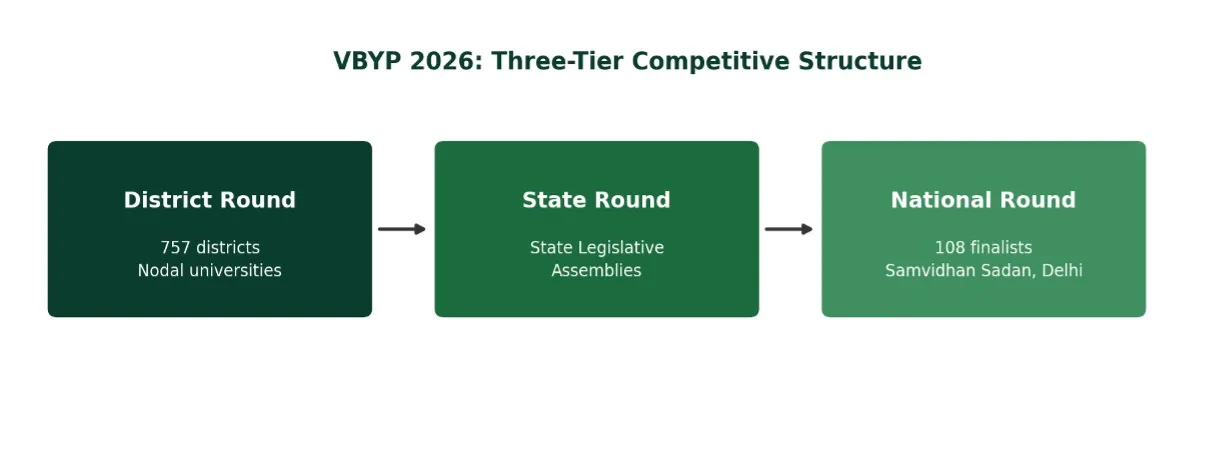
VBYP 2026 took place entirely offline across three levels, District, State and National, with registration handled through the MY Bharat Portal. The District Round was conducted at nodal universities and institutions across 757 districts. Participants had the option to speak in twelve languages, which not only reflects the scale of India’s linguistic diversity but also the scale of the exercise itself. This year, the theme at the district level was ‘50 Years of Emergency: Lessons for Indian Democracy’, inviting participants to engage with a defining chapter of India’s constitutional history – the 1975-77 Emergency, when Fundamental Rights were suspended nationally – and to reflect on its lessons for democratic institutions today.
The top performing participants from each district advanced to the State Round, held inside State Legislative Assemblies under the presidency of State Speakers and Governors. The theme at the State Level was ‘Union Budget 2026: Yuva Shakti Driven Budget’. From each State and Union Territory, the top three performers advanced to the National Round held in Delhi.
At each stage, the jury panel comprised of Members of Parliament, state legislators, senior government officials, academicians, journalists and civic entrepreneurs. This kept the judging process broad and diverse.
All 108 finalists took part in the parliamentary proceedings at the national level – through Opening Remarks, a mock Question Hour, and General and Short-Duration Discussions modelled on actual parliamentary procedure. The participants had to articulate arguments, defend positions with evidence and work within the procedural rules that govern real legislative debate.
The theme at the National Level was ‘Nari Shakti Vandan: Catalyzing Inclusivity and Viksit Bharat 2047’. The event was formally inaugurated on 16 June by Lok Sabha Speaker Shri Om Birla, alongside Union Minister Dr Mansukh Mandaviya and Secretary of Youth Affairs Dr Pallavi Jain Govil. In his address, Shri Birla spoke of the democratic principles embedded in the Constitution, pointing in particular to the immediate adoption of universal adult franchise at independence as a marker of India’s commitment to equality. He also referred to the growing presence of women in grassroots governance – citing that women’s representation in local bodies had touched 50 percent in several states – and linked this to the Nari Shakti Vandan Adhiniyam, the law providing for reservation of seats for women in State Assemblies and the Lok Sabha, as a step towards extending that representation upward. Dr Mandaviya, for his part, spoke about India’s demographic profile, noting that close to 65 percent of the population is under the age of 35, and called on young participants to direct that collective energy towards nation-building.
As a part of the Resolution Drafting Session of the National Round, the finalists worked collectively to turn three days of debate into a formal set of recommendations, consolidated into a Final Resolution, which made the entire process much more meaningful than a mere ceremonial exercise.
The 108 finalists that reached the Samvidhan Sadan represent a fraction of a much larger pool of participants. District and State Round participation data – spanning 36 States and Union Territories and 794 district-level nodes – puts the scale of the exercise in sharper relief: 53,332 young people took part at the district level, of whom 3,090 advanced to the State Round, an overall advancement rate of under 6 percent.
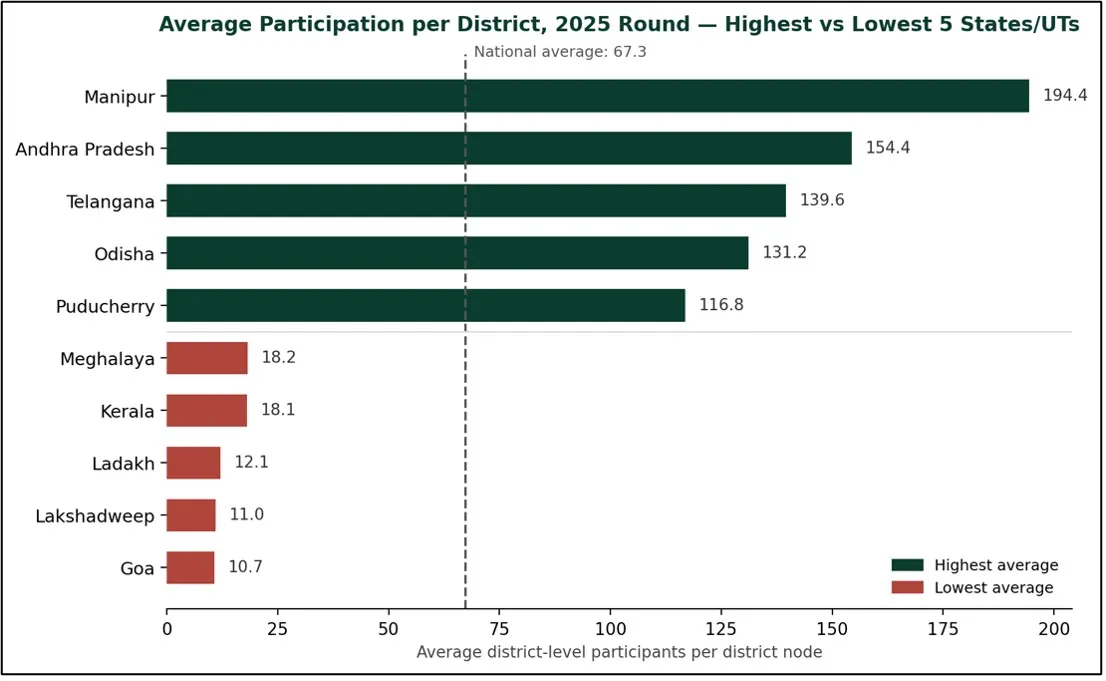
The average number of district-level participants per district node stood at 67.3 nationally, but that average also masks the wide variation. Manipur (194.4), Andhra Pradesh (154.4), Telangana (139.6), Odisha (131.2) and Puducherry (116.8) recorded averages two to three times the national mean. At the other end, Goa (10.7), Lakshadweep (11.0), Ladakh (12.1), Kerala (18.1) and Meghalaya (18.2) recorded averages a fraction of the national mean.
The shift from district to state level adds a second layer to this picture. States with the largest applicant pools converted the smallest share of them: in Manipur and Andhra Pradesh, the two highest-participation states, under 2.5 percent of district-level entrants advanced to the State Round, while smaller-pool States/UTs such as Lakshadweep and Goa saw 20-45 percent of their participants advance. This pattern is consistent with a district-anchored selection design – one that reserves a minimum number of state-round seats per district rather than ranking all entrants nationally by score.
A gender pattern is also worth noticing. At the district level, participation was close to even – 51.5 percent male, 48.5 percent female. Among those who advanced to the State Round, however, women were in the majority, at 55.3 percent against 44.7 percent men. In conversion-rate terms, female participants advanced from district to state level at roughly 6.6 percent, compared to about 5 percent for male participants. Although this is one year of data from one round of the programme, but it sits alongside the National Round’s own theme this year, “Nari Shakti Vandan”, in a way that invites a closer look at how gender plays out through the rest of the pool, including at the National Round itself.
What distinguishes VBYP from a typical debate competition is its reach. By anchoring the District Round in local universities and colleges – and by opening the digital gateway through the MY Bharat portal – the programme has extended participation to youth from the North-East, tribal districts and rural communities, regions that are often under-represented at national-level platforms. Each university involved was made responsible for logistics, venue arrangements and mobilising participation from educational institutions within its district, working alongside district-level committees that included Department of Youth Affairs officials, District Youth Officers, District Education Officers and NSS Programme Officers.
Youth parliaments are not a uniquely Indian idea – similar models exist in various forms around the world – but the scale of VBYP-2026, spanning 757 districts and involving contestants from every state and union territory, makes it one of the largest exercises of its kind. The real outcome of VBYP 2026 will be written in the months ahead, as the Final Resolution and the ideas these 108 young Indians debated find out whether they can travel from the Central Hall into the corridors of policy.
About Anushree Rai
Anushree Rai is a lawyer with a keen interest in Public Policy, Human Rights and Humanitarian Affairs, with experience across the United Nations, Ministries, National and State Commission, Think Tanks and NGOs. She was deployed at the Ministry of Youth Affairs and Sports, Government of India, as a part of the Embark India Development Fellowship (GRAAM).