The Missing Credit: Why India's Young Volunteers Deserve Formal Recognition
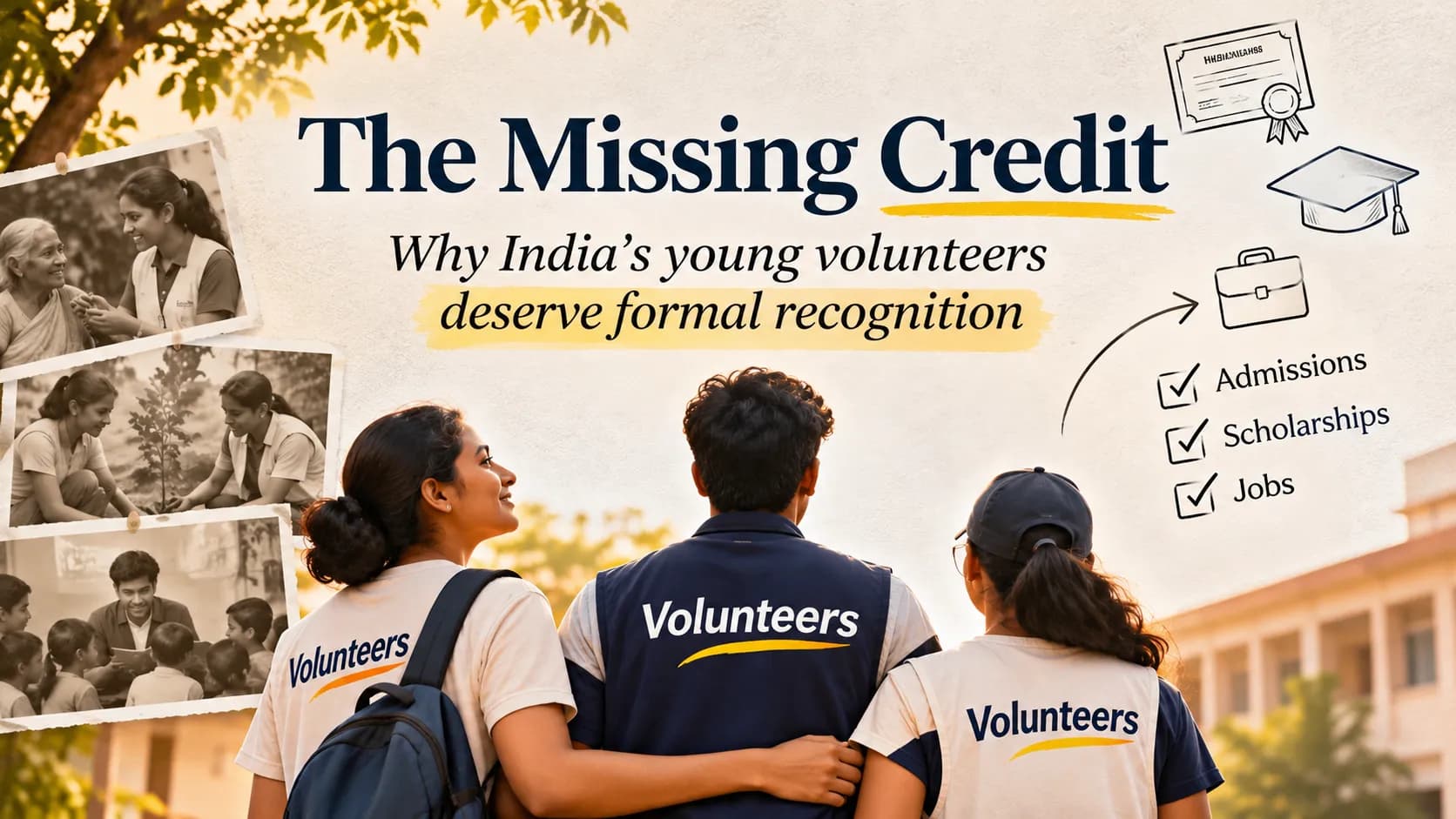
Why India's Young Volunteers Deserve Formal Recognition · Image: .
Every Indian child has grown up listening to stories that never came from textbooks.
Our grandparents told us about the stranger who helped a traveller without expecting anything in return. About the woman who quietly fed hungry children every evening. About the village that came together to build a well before anyone thought about who would get the credit. They taught us sayings like Neki kar, dariya mein daal, do good and forget about it, or Seva Parmo Dharma, service is the highest duty.
Those stories shaped generations. They taught us that the greatest acts are often the ones done without applause.
But somewhere along the way, as we embraced the digital age, we also developed an irresistible urge to measure everything. We measure a student's potential through marks, certificates, and rankings. We measure restaurants through stars, products through reviews, countries through happiness indices, and even ourselves through likes, followers, and engagement. It has become so natural that we casually ask a friend, "How was your trip? Rate it from 1 to 10." Even the innocent joy of picking up an ice cream is interrupted by a quick glance at the compulsory calorie count printed on the wrapper.
Why do we do this? Because numbers are simple. They make comparison effortless. They help us benchmark, analyse, and reproduce outcomes. A single score often communicates what pages of explanation cannot. In a world overflowing with information, scales have become our universal language. They help us make sense of complexity and enable tangible outcomes.
Yet, one of the most meaningful things a young person can do – volunteer their time for their community – remains measured only in the loosest sense; hours logged in a register, certificates handed out, a handful of exceptional volunteers honoured with an award, but rarely converted into something that counts where it matters: an admission form, a scholarship application, a job résumé.

As a volunteer with the National Service Scheme (NSS), I spent countless hours assisting visually impaired students with coursework and helping them navigate a campus that was not always designed with their needs in mind. At the time, I never thought of documenting the impact. None of it felt extraordinary. It simply felt like the right thing to do. But years later, when I sat down to prepare my résumé, I realised something striking. Hundreds of hours of service – hours that had shaped my leadership, strengthened my empathy, taught me teamwork, communication, patience, and resilience – had been condensed into a single line under “Extra-Curricular Activities”.
This is not a personal grievance; it is a structural one, and the numbers make it visible. An NSS volunteer is expected to complete 120 hours of regular activities each year over two consecutive years, along with participation in a seven-day special camp, to qualify for the completion certificate. The scheme's official guidelines make clear that volunteering involves sustained engagement with the community, rather than simply accumulating hours. Over 38 lakh students are enrolled in NSS today (Press Information Bureau, 2026) , each logging hundreds of hours of discipline and community work. Over 3 crore young Indians are registered on the MY Bharat portal alone. (Press Information Bureau, 2026)
Yet, a student who completes hundreds of hours of community service may still find that the experience carries limited formal weight in college applications, scholarship assessments or employment processes. Efforts to fix this exist; Bihar's state universities, for instance, approved a two-credit NSS course in 2026 (Bihar Lok Bhawan, 2026) – but such steps remain scattered exceptions, not a system. Admission committees still weigh entrance scores. Scholarship panels still weigh certificates and marksheets. Recruiters still weigh degrees and internships. Volunteering, when it appears at all, survives as a bullet point, never a credential.
The scale of this gap is telling. By some estimates, barely one in five Indians volunteer their time in a given year, well below the global average of roughly one in four. However, as the numbers speak, the willingness has never been the problem. The architecture to recognise it has.
Other countries have already begun building that architecture, and 2026 – declared by the United Nations as the International Year of Volunteers for Sustainable Development – makes this the moment to look closely at what they do.
South Korea's 1365 Volunteer Portal feeds every verified certificate directly into a student's official school record, and a strong service history earns extra points in national service and government recruitment screenings later in life (South Korean Government – DOVOL Youth Volunteering System). In Beijing, universities convert verified volunteer hours into academic credit, and a strong record opens doors in education, employment and public services (Beihang University - Official Course Requirements) . Europe's Youthpass takes a different route: since 2007 it has issued more than a million certificates documenting specific competencies – teamwork, communication, initiative – in language employers recognise, making it a routine line on a European CV rather than an afterthought. And the question of whether recognition helps or hurts is no longer speculative: a quasi-experimental study in Hong Kong found that banking volunteer hours increased the amount of time people volunteered, with no evidence that it crowded out their underlying motivation to serve (Lin, Shuheng, et al. 2025). Different countries, different mechanisms – but the same lesson: recognition and selflessness are not at odds.
This disconnect is beginning to change in our country as well.
The National Education Policy 2020 recognises volunteerism and community participation as integral to education, and the Academic Bank of Credits already exists to make such learning portable. The University of Mumbai has gone further, treating NSS as a two-credit course: sixty hours of verified service each semester, feeding directly into a student's Academic Bank of Credits entry. MY Bharat, with its Volunteering Opportunities (VO) hosted on the MY Bharat Portal on the national scale, and network of NSS Programme Officers and District Youth Officers (DYOs) verifying every logged activity, already functions as a national ledger of service. These are important milestones. What is missing is simply the last connection.
Three steps would make that connection real. First, the UGC and AICTE should notify a uniform hours-to-credit ratio for verified volunteering service, so recognition does not depend on which university a student happens to attend. Second, MY Bharat's verification system should be integrated directly with the Academic Bank of Credits, so hours logged and checked by a Programme Officer convert into credit without a separate application. Third, universities, scholarship committees and public-sector recruiters should be required to weigh a verified service record alongside marks and interviews – not as a tie-breaker, but as a criterion in its own right, carried through a portable Impact Transcript issued alongside the academic one. Such a system could lay the foundation for a nationally recognised Volunteer Credit Framework, ensuring that every verified hour of meaningful community service carries lasting academic and professional value.
India already honours exceptional contributions through the National Youth Awards, the NSS Awards, and many other forms of public recognition. The next step is different; it is about ensuring that every young person who gives their time and effort to society can also have that experience recognised as a valuable part of their learning and development.
Volunteerism deserves to be seen not just as an act of service, but as an experience that builds skills, character and responsible citizenship. And when service is recognised, more young people venture into service, without displacing the motivation that brought the first volunteer to the door.
Neki kar, dariya mein daal was never meant to imply that society should ignore good deeds. It meant that those who serve should do so without expectation. The responsibility to remember, however, belongs to society.
In the year the United Nations has set aside to recognise volunteers, India has the chance to move seva from a story it tells about itself to a system it builds around itself.
About the Author
Bidhu Khanna is an Embark India Development Fellow (GRAAM) placed with the MY Bharat Section, Department of Youth Affairs, Ministry of Youth Affairs & Sports, Government of India. Her work focuses on youth engagement, public policy and programme effectiveness, with a particular interest in translating policy objectives into meaningful on-ground outcomes.
About the Co-Author
Neelam Choudhary is a Young Professional with the Department of Youth Affairs, Ministry of Youth Affairs & Sports, Government of India, working on youth engagement, policy research and programme implementation through MY Bharat.
Author's note: The first-person NSS experience described in this article is Bidhu Khanna's personal experience. The views expressed in this article are those of the authors in their personal capacities and do not necessarily represent the official position of the Ministry of Youth Affairs & Sports or the Government of India.