What is the real issue behind the Election Commission’s internal conflict?
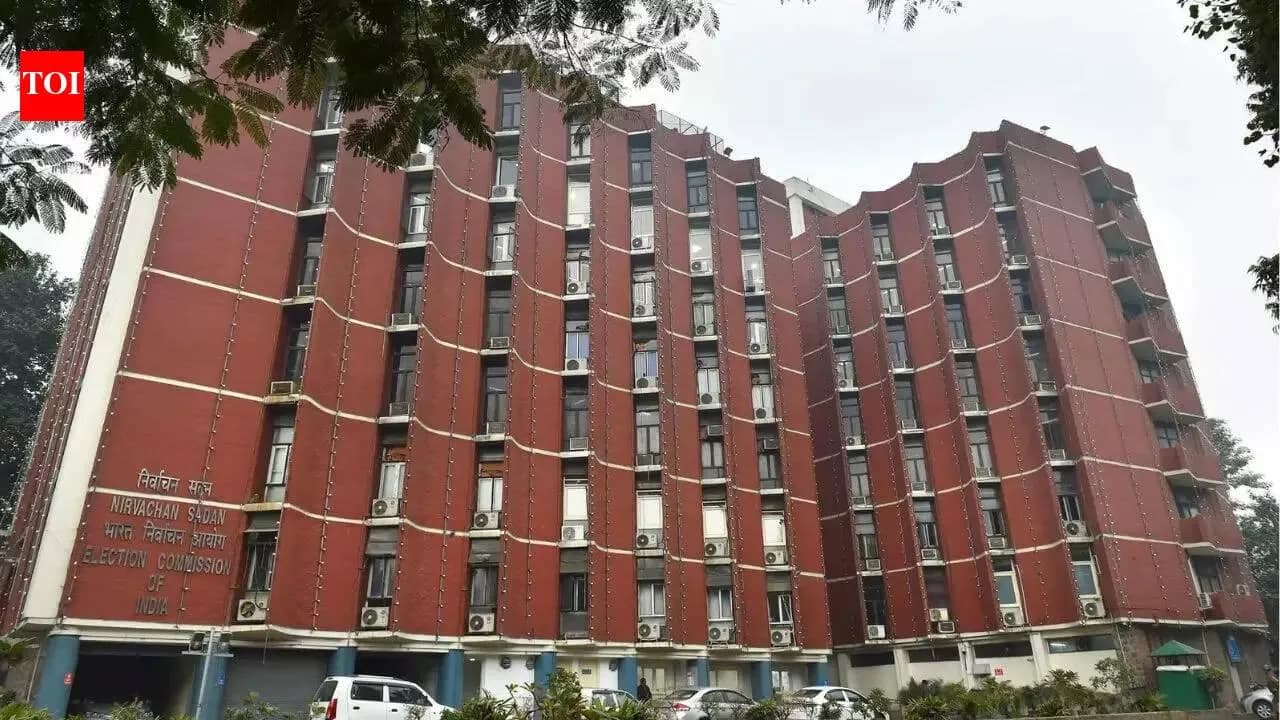
Nirvachan Sadan, the headquarters of the Election Commission of India, in New Delhi. · Image: Timesofindia.indiatimes
There are concerns that Gyanesh Kumar, the individual responsible for ensuring India's democratic process runs smoothly, is gaining control.
These concerns arose after The Indian Express published an "investigative article by Ritika Chopra" (https://indianexpress.com/article/express-exclusive/election-commission-sir-14-objections-gyanesh-kumar-sukhbir-singh-sandhu-vivek-joshi-10889737/) on 23 September 2026, discussing increasing tensions between the Chief Election Commissioner and the two Election Commissioners.
What is happening?
The "Election Commission of India (ECI)" (https://www.eci.gov.in/) is an independent constitutional body established under "Article 324 of the Indian Constitution" (https://www.constitutionofindia.net/articles/article-324-superintendence-direction-and-control-of-elections-to-be-vested-in-an-election-commission/). It oversees the electoral process, including the preparation and revision of electoral rolls. Its current members are Gyanesh Kumar (Chief Election Commissioner), Sukhbir Singh Sandhu and Vivek Joshi (Election Commissioners).
Although Kumar chairs the Commission, he does not have unilateral decision-making power. Under "Section 18 of the Chief Election Commissioner and Other Election Commissioners Act, 2023" (https://www.indiacode.nic.in/indiacode/bitstream/123456789/19721/1/a2023-49.pdf), the Commission's business and allocation of functions should be regulated unanimously. Its business should be conducted unanimously wherever possible. If opinions differ, the majority prevails.
The Election Commissioners are appointed by the President following recommendations from a selection committee. "Section 7 of the 2023 Act" (https://www.indiacode.nic.in/indiacode/bitstream/123456789/19721/1/a2023-49.pdf) states that this committee comprises the Prime Minister, a Union Cabinet Minister nominated by the Prime Minister and the Leader of the Opposition in the Lok Sabha.
In March 2023, the Supreme Court established an interim appointment process until Parliament passed a law. The selection committee then comprised the Prime Minister, Leader of the Opposition and Chief Justice of India. The "Supreme Court's judgment in Anoop Baranwal v. Union of India" (https://indiankanoon.org/doc/111828604/) explains this arrangement. The 2023 Act replaced the CJI with a Union Cabinet Minister nominated by the Prime Minister, a change that has prompted debate.
Other officials are also involved in preparing electoral rolls. Each state has a Chief Electoral Officer who oversees their preparation and revision, while District Election Officers oversee election activities in their districts.
At constituency level, an Electoral Registration Officer (ERO) is responsible for preparing and revising the electoral roll under "Section 13B of the Representation of the People Act, 1950" (https://indiacode.ecourtsindia.com/representation-people-act-1950/section/13B/). EROs can correct, transpose or delete entries under "Section 22" (https://indiacode.ecourtsindia.com/representation-people-act-1950/section/22/) and handle applications for inclusion under "Section 23" (https://indiacode.ecourtsindia.com/representation-people-act-1950/section/23/). If an eligible person is missing from the roll, they cannot vote.
Digital systems support this process. ERONet is used to manage electoral rolls, while "ECINET was launched on 22 January 2026" (https://www.pib.gov.in/PressReleasePage.aspx?PRID=2217429&lang=1®=3) as a one-stop digital platform bringing several election-related services together. However, the responsibility for electoral rolls remains with authorised officers.
If 500 names are flagged by a system, does that mean they are all duplicates or ineligible? No. They need to be investigated. Two people with similar names cannot automatically be treated as the same person. Systems can flag issues, but officers must examine them and follow the correct procedure.
This became important during the Special Intensive Revision (SIR), a large-scale initiative to update electoral rolls. Booth Level Officers visit people's homes to distribute and collect enumeration forms, checking voter details and identifying deceased, shifted, absent, untraceable or duplicate voters.
According to "The Indian Express on 1 September 2026" (https://indianexpress.com/article/india/election-commission-sir-draft-rolls-13-crore-deletions-delhi-leads-10857760/), approximately 13.37 crore names had been removed from draft rolls across 30 states and Union Territories. This represented around 14.1% of the pre-SIR electorate. These deletions did not necessarily mean everyone concerned was ineligible. Names could be removed due to death, permanent migration, absence or duplicate registration. Eligible voters could submit claims or objections.
What if a digital system prevents an authorised officer from completing a valid claim?
During Goa's SIR, voters were flagged because their details did not match those of their parents or grandparents in previous electoral rolls. On 29 January 2026, the Supreme Court issued directions in SIR-related proceedings, requiring that affected voters be given an opportunity to submit evidence and objections. The Court expected these procedural directions to be followed in all states where the SIR was ongoing. In Goa, 649 voters came forward with documents or objections. EROs and Assistant EROs examined their cases and found 97 eligible for inclusion in the final roll, according to "The Indian Express's investigation" (https://indianexpress.com/article/express-exclusive/election-commission-goa-sir-voter-deletion-ecinet-10891422/lite/).
Between 11 and 17 February, the Goa CEO's office sent eight communications seeking a way to reverse the removals. However, the facility was not enabled before the final roll was published on 21 February, leaving the 97 voters off the roll at that stage. On 18 February, Deputy Election Commissioner Sanjay Kumar told the IT division that the system should not prevent authorities from following the Supreme Court's directions.
The ECI told "India Today" (https://www.indiatoday.in/india/story/ecinet-no-rollback-goa-97-voters-final-electoral-roll-sir-controversy-3001987-2026-09-24) that ECINET had no rollback facility after a Form 7 deletion, while maintaining that EROs could add or remove names through the prescribed process.
On 25 September, the Goa CEO's office stated that many of these voters had been added using Form 6 and that the remaining cases were being processed.
The ECI subsequently announced a committee to review ECINET, chaired by a Senior Deputy Election Commissioner and including an independent expert from an IIT or IIIT. It also promised greater flexibility for field officers and consultation with officers on future IT initiatives. Its "26 September press release" (https://www.pib.gov.in/PressReleasePage.aspx?PRID=2315309&lang=1®=1) stated that 81 of the 97 voters had already submitted Form 6 applications.
Goa was not the only place where concerns were raised. "The Indian Express found" (https://indianexpress.com/article/express-exclusive/election-commission-sir-14-objections-gyanesh-kumar-sukhbir-singh-sandhu-vivek-joshi-10889737/) that Sandhu and Joshi had officially objected to at least 14 issues over 10 months. These fell into four categories.
The first concerned Form 6, the application used by eligible individuals to register as voters. In May 2026, a declaration was proposed for the online form, asking whether the applicant, their parents or grandparents had appeared on the electoral roll during the previous SIR. Joshi objected on 16 May, stating that Form 6 was a statutory form and the proposed change should be referred to the Government. Sandhu agreed on 19 May. However, the declaration appeared on the online system in July. Although it was not officially mandatory, applicants could not proceed without answering it. Sandhu objected again on 13 August, calling the change unauthorised and illegal. These objections were detailed in "The Indian Express's report" (https://indianexpress.com/article/express-exclusive/election-commission-illegal-changes-form-6-gyanesh-kumar-10889714/).

The second concerned the centralisation of voter data. In May, Joshi called for an audit to ensure that only officers with the appropriate statutory powers could access the database. In August, Sandhu stated that state officers did not have full access to ERONet and questioned the authority of the Commission's Director General of IT to restrict their access.
The third concerned appeals to tribunals in West Bengal. Approximately 38.31 lakh appeals were filed, including 16.10 lakh against the inclusion of voters. "The Indian Express reported" (https://indianexpress.com/article/india/west-bengal-electoral-rolls-ec-supreme-court-appeals-deleted-voters-10885130/) that Sandhu questioned who had authorised these appeals on behalf of the ECI. He stated that neither he, Joshi nor the West Bengal Chief Electoral Officer had been informed about why they had been filed.
The fourth concerned work allocation. A new order was issued on 28 July 2026. Joshi objected because he had not been consulted about the changes and had not received a file he had requested. The following day, Sandhu and Joshi wrote separately to Cabinet Secretary T. V. Somanathan, expressing their concerns. On 30 July, both commissioners jointly set aside the new work allocation order, citing provisions of the 2023 Act. These developments were documented in "Ritika Chopra's investigation" (https://indianexpress.com/article/express-exclusive/election-commission-sir-14-objections-gyanesh-kumar-sukhbir-singh-sandhu-vivek-joshi-10889737/).
On 24 September, the ECI stated that the commissioners' notes were part of the normal decision-making process and that differences of opinion were common. It said all decisions over the previous year, including those concerning the SIR, had been unanimous. It also referred to security measures in its digital systems and reiterated that EROs and DEOs had statutory powers. Read "The Indian Express's report on the response" (https://indianexpress.com/article/india/decisions-unanimous-election-commission-response-sir-vote-express-investigation-gyanesh-kumar-10890491/).
However, this response did not specifically address several questions: who authorised the changes to Form 6, who authorised the West Bengal appeals and why the full Commission had not met between May and August.
On 26 September, all three commissioners met. The Commission announced an ECINET review, greater flexibility for field officers and clearer procedures for future IT initiatives. It also clarified that the SIR declaration attached to Form 6 had been upheld by the Supreme Court, while the forms prescribed under the Registration of Electors Rules, 1960, would be used outside the SIR. The Commission added that the new work allocation order had not been implemented and that oversight of the IT division had never been withdrawn. These details appear in the "official press release" (https://www.pib.gov.in/PressReleasePage.aspx?PRID=2315309&lang=1®=1).
Elections are often referred to as democracy's backbone. The ECI is responsible for protecting this process. When two of the three commissioners raise objections and election officers question the systems they use, the public deserves clear answers. The Commission has provided explanations and stated that some concerns have been addressed. However, if those in charge of our elections cannot agree on how authority is exercised, who really is in charge?